Recent Posts
Email design resources
- laura
- Aug 28, 2014
One of the more frequent questions I get that I can’t answer is how to design a good email. Design is just not my strong point and outside actually getting the HTML right, what an email looks like doesn’t have a whole lot to do with delivery. It was pointed out to me today that the nice people over at Mailchimp have a resource page for designing emails. It’s a good mix of theory and explanation and some code examples.
Very useful if you’re trying to create pretty HTML emails from scratch.
Who pays for spam?
- laura
- Aug 26, 2014
A couple weeks ago, I published a blog post about monetizing the complaint stream. The premise was that ESPs could offer lower base rates for sending if the customer agreed to pay per complaint. The idea came to me while talking with a deliverability expert at a major ESP. One of their potential customer wanted the ESP to allow them to mail purchased lists. The customer even offered to indemnify the ESP and assume all legal risk for mailing purchased lists.
While on the surface this may seem like a generous offer, there aren’t many legal liabilities associated with sending email. Follow a few basic rules that most of us learn in Kindergarten (say your name, stop poking when asked, don’t lie) and there’s no chance you’ll be legally liable for your actions.
Legal liability is not really the concern for most ESPs. The bigger issues for ESPs including overall sending reputation and cost associated with resolving a block. The idea behind monetizing the complaint stream was making the customer bear some of the risk for bad sends. ESP customers do a lot of bad things, up to and including spamming, without having any financial consequences for the behavior. By sharing in the non-legal consequences of spamming, the customer may feel some of the effect of their bad decisions.
Right now, ESPs really protect customers from consequences. The ESP pays for the compliance team. The ESP handles negotiations with ISPs and filtering companies. The cost of this is partially built into the sending pricing, but if there is a big problem, the ESP ends up shouldering the bulk of the resolution costs. In some cases, the ESP even loses revenue as they disconnect the sender.
ESPs hide the cost of bad decisions from customers and do not incentivize customers to make good decisions. Maybe if they started making customers shoulder some of the financial liability for spamming there’d be less spamming.
A new way of reading email
- laura
- Aug 22, 2014
Fastcompany reports that AOL has a new webmail client “Alto” that changes how email is read and received.
Read MoreUnsubscribing is hard
- laura
- Aug 20, 2014
A comment came through on my post about unsubscribing that helpfully told me that the problem was I didn’t unsubscribe correctly.
As you know, there are usually two unsubscribe options in many of the bulk senders emails. Are you unsubscribing from the global or the offer unsub? Unless you are unsubscribing from both, you will still be on the lists.
To address the underlying question, I did unsubscribe from both links for those very few mails in my mailbox that had double unsubscribe links. I know that some spammers use multiple unsubscribe links in their emails. We routinely recommend clients not use 3rd party mailers with double unsubscribes because it’s a clear sign the 3rd party mailer is a spammer.
Given the presence of double unsubscribes I generally assume the point is to confuse recipients. By having multiple unsubscribe links the spammers can ignore unsubscribe requests with the excuse that “you unsubscribed from the wrong link.” Plausible deniability at its finest. The best part for the spammer is that it doesn’t matter which unsubscribe link the recipient picks, it will always be the Wrong One.
I’ve been dealing with spam since the late 90s, and have been professionally consulting on delivery for over 14 years. If I can’t figure out what link to use to unsubscribe, how is anyone supposed to figure out how to make mail stop?
In some cases, the unsubscribe links admitted that the address I was trying to unsubscribe was already removed from the list. They helpfully refused to let me unsubscribe again through their form. But they offered a second way to unsubscribe.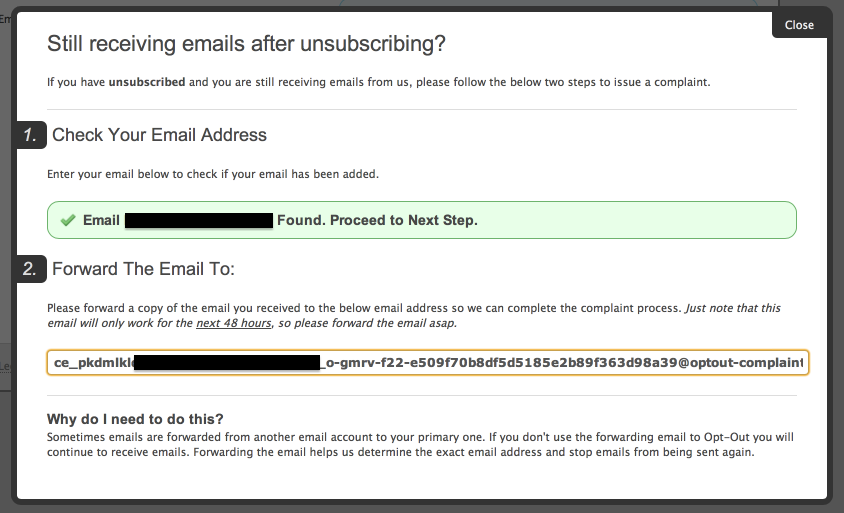
The address I was unsubscribing was the same one I was unsubscribing. Some of the emails even helpfully told me “this email was sent to trapaddress@” which is the address in the above screenshot.
I’m sure my friend will come back and comment with “why didn’t you unsubscribe by forwarding the email?” Because I was spending enough time unsubscribing as it was, and I didn’t want to have to try and navigate yet another unsubscribe process. I knew they weren’t going to stop mailing me, no matter what hoops I jumped through.
I’m not saying that all unsubscribe processes are broken, there are millions and millions of emails sent every day with simple and effective unsubscribe links. What I am saying is that there is a lot of mail getting to inboxes that users never requested nor wanted. “Just unsubscribing” from this mail Does Not Work. It just keeps coming and coming and coming.
But of course, the mail still coming is my fault, as I was unable to correctly unsubscribe. 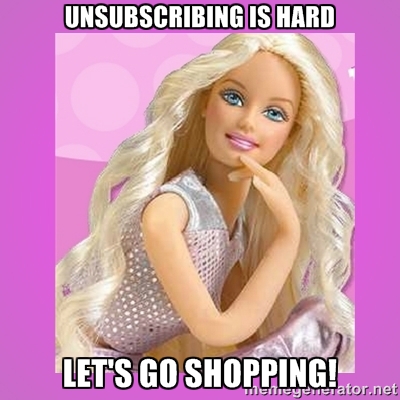
Yes, spam is actually still a problem
- laura
- Aug 19, 2014
I hear a lot of people claim that spam isn’t really a problem any more. That filters are so good that the average user doesn’t see a lot of spam and if they do get “legitimate” mail that they can just opt out.
These are great sounding arguments, the problem is that those arguments aren’t always true.
There is an address I stopped using for commercial mail around 1997 and all mail around 2002. It still gets hundreds of emails a month.
Those hundreds of emails a month are despite the fact that the address is behind commercial spam filters. It’s been on “flamers lists.” It’s on the “do not mail” list that came with the “Millions CD.”
In addition, I am very open with clients (and their affiliates) that this is a “spam trap” address. I’ve handed it out to dozens and dozens of companies over the years describing it as my spam trap address.
In November 2013, I unsubscribed from every single email received at that account – at least those that had unsubscribe links.
What does the mail volume look like now?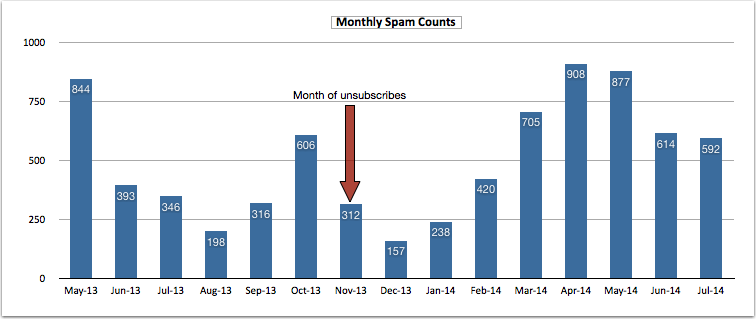
If anything unsubscribing made the volume problems worse. In the best case it lowered the volume briefly to something approaching 10 emails a day.
There are currently over 500 messages I’ve received so far in August. These are messages advertising companies like Laura Ashley, MetLife, Military.com, Quibids, Walk In Tubs, Sainsbury’s, Bloomburg, Fidelity, Oral B, Lasix Vision Institute, Virgin Broadband, ClickNLoan, Timeshares, iMotors, Walmart, oil changes, Experian, Credit monitoring, Life insurance, ADT, CHW Home Warranty, Health Plans of America, Bosley Hair Solutions, Jillian Michaels Online, restaurant coupons, credit cards, SBA loans, and that’s before we get to the Garcinia cambogia, herbal viagra and clearly fraudulent stuff.
This account, that hasn’t been subscribed to anything in more than 10 years is getting hundreds of unasked for emails a month, even with the benefit of commercial filters. It appears to be being sold or traded in multiple countries (Laura Ashley, Virgin Broadband and Sainsbury’s are all in the UK). I don’t want this mail. I have tried to stop getting this mail.
Yes, spam is still a problem.
Email saves trees!
- laura
- Aug 14, 2014
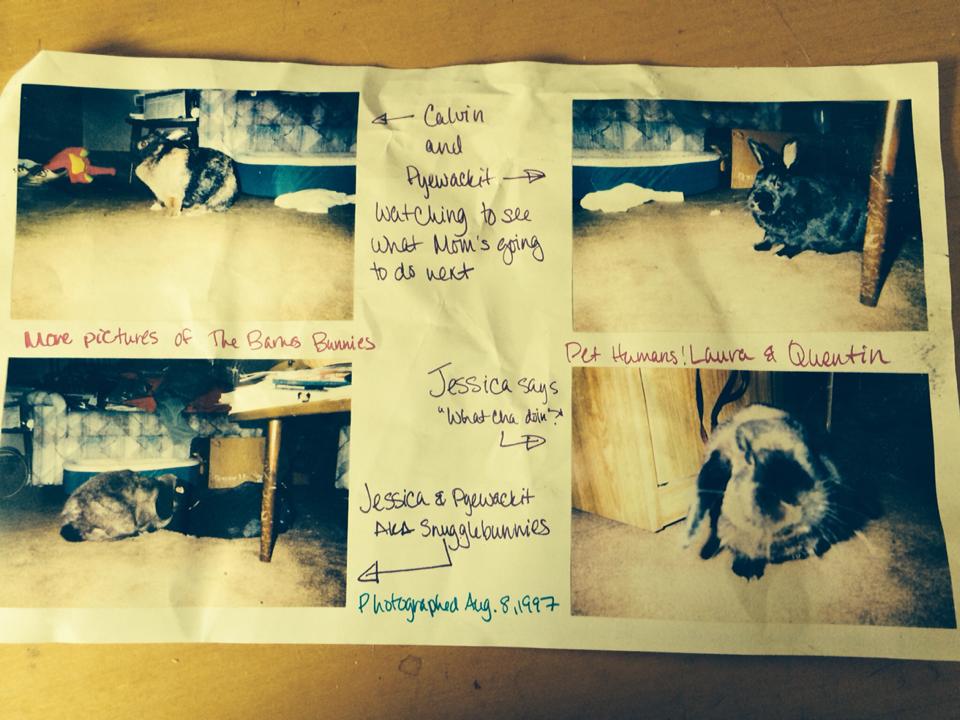
The arrival of my first spam email was a bit of a shock. I’d been on the internet for years by that point and had never seen junk mail in my inbox. Of course, the Internet was a very different place. The web was still a toddler. There was no email marketing industry. In fact, there wasn’t much commerce on the web at all. Much of the “surfing” I did was using gopher and ftp rather than the fancy new web browser called NCSA Mosaic. To share pictures we actually had to send printouts by postal mail.
It wasn’t just getting spam that was memorable (oh, great! now my inbox is going to look like my postal box, stuffed full of things I don’t want), it was the domain name: savetrees.com. Built into the domain name was an entire argument defending spam on the grounds of environmental friendliness. By sending spam instead of postal mail we could save the earth. Anyone who didn’t like it was morally corrupt and must hate the planet.
Why do I mention this history? During a discussion on a list for marketers earlier this week, multiple people mentioned that email marketing was clearly and obviously the much more environmentally sound way to do things. I mentioned this over on Facebook and one of my librarian friends (who was one of the people I was email friends with back in those early days) started doing her thing.
She posted her findings over on the Environmental News Bits blog: The comparative environmental impact of email and paper mail. It’s well worth a read, if only because a lot of companies have really looked into the issue in great detail. Much greater detail than I thought was being put into the issue.
I shared one of the links she found, the 2009 McAfee study, with the email marketing group discussing the issue. (You may want to put down the drinks before reading the next line.) It was universally panned as marketing and therefore the conclusions couldn’t be trusted.
Anyone who pays any attention knows that nothing we do and none of the choices we make are environmentally neutral. Plastic bags were supposed to save trees from becoming paper bags, but turned into an environmental mess of their own.
Simple slogans like “email saves trees” might make marketers feel better, and may have gained Cyberpromo a strong customer base in the early days. But the reality is different.
Protecting users from look-alike accounts
- laura
- Aug 14, 2014
Gmail recently started accepting mail (and calendar invitations) with non-Latin characters. A lot of fraudulent emails use non-Latin characters as a way to fool users. Google is on top of these security issues, however, and is now throwing away some mail with non-Latin characters.
Read MoreNominations for the J.D. Falk Award
- laura
- Aug 12, 2014
J.D. Falk was one of the first names I encountered when learning how to read headers and report spam back in the mid-90s. He was one of the folks leading the fight against spam and actively trying to improve the Internet. When I was hired by MAPS I got to work with J.D. and a number of other big-names. One of the things that really surprised me was that this “internet elder” I had imagined was younger than me and with much bluer hair.
After MAPS imploded, J.D. and I carved out separate careers. He went to work at a number of major mailbox providers and I started delivery consulting. Our paths crossed occasionally, usually at conferences, but we also were on a number of mailing lists together. I kept an eye on J.D and his impact on email delivery. In fact, J.D. was responsible for a lot of the modern anti-spam techniques implemented at ISPs.
Eventually, he moved to Return Path where he worked on their Receiver Support group; even as he continually argued against the false sender / receiver dichotomy that so many people endorse.
M3AAWG, with financial support from Return Path, created the J.D. Falk award to recognize people who work to create a better online world. Nominations for the 3rd annual J.D. Falk award are now open. The M3AAWG website has more details.
Email templates
- laura
- Aug 11, 2014
SendwithUs is crowdsourcing and open sourcing email templates. These are tested templates submitted by the SendwithUs community and run through the Litmus testing suite.
If you’re in the market for a template, or want to share a great template you’ve designed, check out the SendwithUs project.
Unsubscribing from spam, part 3
- laura
- Aug 9, 2014
At the end of last year, I talked a little bit about a project I was working on to see if unsubscribing from spam would actually work. The address I picked was my first non-work/school related email address. It’s been mine since 2004 or so. I stopped using it for anything commerce related back in the late 90s. But it is on a lot of address lists (as it was used to post to Usenet), and a lot of affiliate mailers have it and it gets spam, despite being behind commercial spam filters.
During the month of November, I unsubscribed from every commercial email that came into the account. In total I unsubscribed from 312 messages. We’re now 8 full months after that, and my spam load on that account is only increasing, it was almost triple that amount in April (908 messages).
Unsubscribing from spam does not work. Here’s what 6 months of spam looks like after unsubscribing from every message received in an inbox on an address that is not currently given to anyone (and hasn’t been for more than 10 years). This is also after it’s gone through my ISP spam filters, which do seem to do a decent job of weeding out the botnet spam and phishing.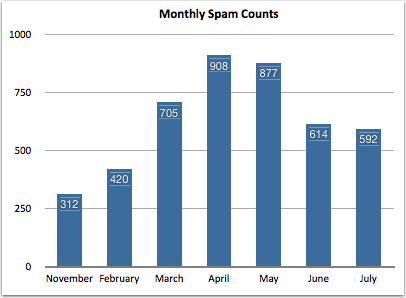
This isn’t, of course, any sort of controlled study and I’ve left a lot of details out of this blog post about the address and about how I handled the project. I do want to write it up and publish it, but it’s a back burner project right now.
One relevant note is about 5 or 6 years ago one of my clients wanted me to look at their affiliates and I was able to pull mail out of this box to show them their affiliates were spamming. They put me on the phone with the affiliate. I explained this was an address I hadn’t used since the late 90’s, before their company existed. They insisted I had given it to them or some company they bought. Even after I used the phrase “spam trap” they still insisted I’d opted in and they didn’t have to stop mailing me.
Another note is that while a lot of these are semi-scammy products, a number of them are legitimate businesses and have broad advertising campaigns in multiple mediums, including television.
For all those people that say “just unsubscribe” it doesn’t always work, at least not for addresses that were on the “millions CD” and the “flamers list” from the “Millions CD.”
Categories
Tags
- 2010
- 2016
- 2fa
- 419
- 4xx
- 554
- 5xx
- @
- Aarp
- Abacus
- Abandoned
- Aboutmyemail
- Abuse
- Abuse Desk
- Abuse Enforcement
- Abuse Prevention
- Academia
- Accreditation
- Acme
- Acquisition
- Address Book
- Addresses
- Administrivia
- Adsp
- Advanced Delivery
- Advertiser
- Advertising
- Advice
- Affiliate
- Affiliates
- After the Email
- Alerts
- Algorithm
- Alice
- Alignment
- Allcaps
- Alt Text
- AMA
- Amazon
- Amp
- Amsterdam
- Analysis
- Anecdotes
- Anti-Spam
- Anti-Spam Laws
- Anti-Spammers
- Antwort
- AOL
- Appeals
- Appearances
- Appending
- Apple
- Arc
- Arf
- Arrest
- Arrests
- Ascii
- Asides
- Ask Laura
- Askwttw
- Assertion
- Assumptions
- ATT
- Attacks
- Attention
- Attrition
- Audit
- Authentication
- Authentication. BT
- Autonomous
- Award
- B2B
- B2C
- Backhoe
- Backscatter
- Backus-Naur Form
- Banks
- Barracuda
- Barry
- Base64
- Base85
- Bcc
- Bcp
- Bear
- Bears
- Behaviour
- Benchmark
- BESS
- Best Practices
- Bgp
- BIMI
- Bit Rot
- Bitly
- Bizanga
- Black Friday
- Blackfriday
- Blacklist
- Blacklists
- Blast
- Blo
- Block
- Blockin
- Blocking
- Blocklist
- Blocklisting
- Blocklists
- Blocks
- Blog
- Blog Links
- Blogroll
- Blogs
- Bob
- Boca
- Bofa
- Book Review
- Bot
- Botnet
- Botnets
- Bots
- Bounce
- Bounce Handling
- Bounces
- Branding
- Brands
- Breach
- Breaches
- Breech
- Bronto
- Browser
- Bsi
- Bucket
- Bulk
- Bulk Folder
- Bulk Mail
- Business
- Business Filters
- Buying Leads
- Buying Lists
- C-28
- CA
- Caa
- Cabbage
- Cache
- Cadence
- CAH
- California
- Campaign
- CAN SPAM
- Canada
- Candy
- Candycandycandy
- Canonicalization
- Canspam
- Captcha
- Career Developmnent
- Careers at WttW
- Cargo Cult
- Case Law
- Cases
- CASL
- Cat
- Cbl
- CDA
- Cert
- Certification
- CFL
- CFWS
- Change
- Charter
- Cheat
- Cheese
- Choicepoint
- Choochoo
- Christmas
- Chrome
- Cidr
- Cisco
- Civil
- Clear.net
- Clearwire.net
- Cli
- Click
- Click Through
- Click Tracking
- Clicks
- Clickthrough
- Client
- Cloudflare
- Cloudmark
- Cname
- Co-Reg
- Co-Registration
- Cocktail
- Code
- COI
- Comcast
- Comments
- Commercial
- Communication
- Community
- Comodo
- Comparison
- Competitor
- Complaint
- Complaint Rates
- Complaints
- Compliancce
- Compliance
- Compromise
- Conference
- Conferences
- Confirmation
- Confirmed (Double) Opt-In
- Confirmed Opt-In
- Congress
- Consent
- Conservatives
- Consistency
- Constant Contact
- Consultants
- Consulting
- Content
- Content Filters
- Contracts
- Cookie
- Cookie Monster
- COPL
- Corporate
- Cost
- Court Ruling
- Cox
- Cox.net
- Cpanel
- Crib
- Crime
- CRM
- Crowdsource
- Crtc
- Cryptography
- CSRIC
- CSS
- Curl
- Customer
- Cyber Monday
- Czar
- Data
- Data Hygiene
- Data Security
- Data Segmentation
- Data Verification
- DBL
- Dbp
- Ddos
- Dea
- Dead Addresses
- Dedicated
- Dedicated IPs
- Defamation
- Deferral
- Definitions
- Delays
- Delisting
- Deliverability
- Deliverability Experts
- Deliverability Improvement
- Deliverability Summit
- Deliverability Week
- Deliverability Week 2024
- Deliverabiltiy
- DeliverabiltyWeek
- Delivery Blog Carnival
- Delivery Discussion
- Delivery Emergency
- Delivery Experts
- Delivery Improvement
- Delivery Lore
- Delivery News
- Delivery Problems
- Dell
- Design
- Desks
- Dhs
- Diagnosis
- Diff
- Dig
- Direct Mag
- Direct Mail
- Directives
- Discounts
- Discovery
- Discussion Question
- Disposable
- Dk
- DKIM
- Dkimcore
- DMA
- DMARC
- DNS
- Dnsbl
- Dnssec
- Docs
- Doingitright
- Domain
- Domain Keys
- Domain Reputation
- DomainKeys
- Domains
- Domains by Proxy
- Dontpanic
- Dot Stuffing
- Dotcom
- Double Opt-In
- Dublin
- Dyn
- Dynamic Email
- E360
- Earthlink
- Ec2
- Ecoa
- Economics
- ECPA
- Edatasource
- Edns0
- Eec
- Efail
- Efax
- Eff
- Election
- Email Address
- Email Addresses
- Email Change of Address
- Email Client
- Email Design
- Email Formats
- Email Marketing
- Email Strategy
- Email Verification
- Emailappenders
- Emailgeeks
- Emails
- Emailstuff
- Emoji
- Emoticon
- Encert
- Encryption
- End User
- Endusers
- Enforcement
- Engagement
- Enhanced Status Code
- Ennui
- Entrust
- Eol
- EOP
- Epsilon
- Esp
- ESPC
- ESPs
- EU
- Ev Ssl
- Evaluating
- Events
- EWL
- Exchange
- Excite
- Expectations
- Experience
- Expires
- Expiring
- False Positives
- FAQ
- Fathers Day
- Fbl
- FBL Microsoft
- FBLs
- Fbox
- FCC
- Fcrdns
- Featured
- Fedex
- Feds
- Feedback
- Feedback Loop
- Feedback Loops
- Fiction
- Filter
- Filter Evasion
- Filtering
- Filterings
- Filters
- Fingerprinting
- Firefox3
- First Amendment
- FISA
- Flag Day
- Forensics
- Format
- Formatting
- Forms
- Forwarding
- Fraud
- Freddy
- Frequency
- Friday
- Friday Spam
- Friendly From
- From
- From Address
- FTC
- Fussp
- Gabbard
- GDPR
- Geoip
- Gevalia
- Gfi
- Git
- Giveaway
- Giving Up
- Global Delivery
- Glossary
- Glyph
- Gmail
- Gmails
- Go
- Godaddy
- Godzilla
- Good Email Practices
- Good Emails in the Wild
- Goodmail
- Google Buzz
- Google Postmaster Tools
- Graphic
- GreenArrow
- Greylisting
- Greymail
- Groupon
- GT&U
- Guarantee
- Guest Post
- Guide
- Habeas
- Hack
- Hacking
- Hacks
- Hall of Shame
- Harassment
- Hard Bounce
- Harvesting
- Harvey
- Hash
- Hashbusters
- Headers
- Heartbleed
- Hearts
- HELO
- Help
- Henet
- Highspeedinternet
- Hijack
- History
- Holiday
- Holidays
- Holomaxx
- Hostdns4u
- Hostile
- Hostname
- Hotmail
- How To
- Howto
- Hrc
- Hsts
- HTML
- HTML Email
- Http
- Huey
- Humanity
- Humor
- Humour
- Hygiene
- Hypertouch
- I18n
- ICANN
- Icloud
- IContact
- Identity
- Idiots
- Idn
- Ietf
- Image Blocking
- Images
- Imap
- Inbox
- Inbox Delivery
- Inboxing
- Index
- India
- Indiegogo
- Industry
- Infection
- Infographic
- Information
- Inky
- Inline
- Innovation
- Insight2015
- Integration
- Internationalization
- Internet
- Intuit
- IP
- IP Address
- Ip Addresses
- IP Repuation
- IP Reputation
- IPhone
- IPO
- IPv4
- IPv6
- Ironport
- Ironport Cisco
- ISIPP
- ISP
- ISPs
- J.D. Falk Award
- Jail
- Jaynes
- JD
- Jobs
- Json
- Junk
- Juno/Netzero/UOL
- Key Rotation
- Keybase
- Keynote
- Kickstarter
- Kraft
- Laposte
- Lavabit
- Law
- Laws
- Lawsuit
- Lawsuits
- Lawyer
- Layout
- Lead Gen
- Leak
- Leaking
- Leaks
- Legal
- Legality
- Legitimate Email Marketer
- Letsencrypt
- Letstalk
- Linked In
- Links
- List Hygiene
- List Management
- List Purchases
- List the World
- List Usage
- List-Unsubscribe
- Listing
- Listmus
- Lists
- Litmus
- Live
- Livingsocial
- London
- Lookup
- Lorem Ipsum
- Lycos
- Lyris
- M3AAWG
- Maawg
- MAAWG2007
- Maawg2008
- MAAWG2012
- MAAWGSF
- Machine Learning
- Magill
- Magilla
- Mail Chimp
- Mail Client
- MAIL FROM
- Mail Privacy Protection
- Mail Problems
- Mail.app
- Mail.ru
- Mailboxes
- Mailchimp
- Mailgun
- Mailing Lists
- Mailman
- Mailop
- Mainsleaze
- Maitai
- Malicious
- Malicious Mail
- Malware
- Mandrill
- Maps
- Marketer
- Marketers
- Marketing
- Marketo
- Markters
- Maths
- Mcafee
- Mccain
- Me@privacy.net
- Measurements
- Media
- Meh
- Meltdown
- Meme
- Mentor
- Merry
- Message-ID
- Messagelabs
- MessageSystems
- Meta
- Metric
- Metrics
- Micdrop
- Microsoft
- Milter
- Mime
- Minimal
- Minshare
- Minute
- Mit
- Mitm
- Mobile
- Models
- Monitoring
- Monkey
- Monthly Review
- Mpp
- MSN/Hotmail
- MSN/Hotmail
- MTA
- Mua
- Mutt
- Mx
- Myths
- Myvzw
- Needs Work
- Netcat
- Netsol
- Netsuite
- Network
- Networking
- New Year
- News
- News Articles
- Nhi
- NJABL
- Now Hiring
- NTP
- Nxdomain
- Oath
- Obituary
- Office 365
- Office365
- One-Click
- Only Influencers
- Oops
- Opaque Cookie
- Open
- Open Detection
- Open Rate
- Open Rates
- Open Relay
- Open Tracking
- Opendkim
- Opens
- Openssl
- Opt-In
- Opt-Out
- Optonline
- Oracle
- Outage
- Outages
- Outblaze
- Outlook
- Outlook.com
- Outrage
- Outreach
- Outsource
- Ownership
- Owning the Channel
- P=reject
- Pacer
- Pander
- Panel
- Password
- Patent
- Paypal
- PBL
- Penkava
- Permission
- Personalities
- Personalization
- Personalized
- Pgp
- Phi
- Philosophy
- Phish
- Phishers
- Phishing
- Phising
- Photos
- Pii
- PIPA
- PivotalVeracity
- Pix
- Pluscachange
- Podcast
- Policies
- Policy
- Political Mail
- Political Spam
- Politics
- Porn
- Port25 Blocking
- Postfix
- Postmaster
- Power MTA
- Practices
- Predictions
- Preferences
- Prefetch
- Preview
- Primers
- Privacy
- Privacy Policy
- Privacy Protection
- Private Relay
- Productive Mail
- Promotions
- Promotions Tab
- Proofpoint
- Prospect
- Prospecting
- Protocols
- Proxy
- Psa
- PTR
- Public Suffix List
- Purchased
- Purchased Lists
- Purchases
- Purchasing Lists
- Questions
- Quoted Printable
- Rakuten
- Ralsky
- Rant
- Rate Limiting
- Ray Tomlinson
- Rc4
- RDNS
- Re-Engagement
- Read
- Ready to Post
- Readytopost
- Real People
- Realtime Address Verification
- Recaptcha
- Received
- Receivers
- Recipient
- Recipients
- Redirect
- Redsnapper
- Reference
- Registrar
- Registration
- Rejection
- Rejections
- Rejective
- Relationship
- Relevance
- Relevancy
- Removals
- Render Rate
- Rendering
- Replay
- Repost
- Repudiation
- Reputation
- Requirements
- Research
- Resources
- Responsive
- Responsive Design
- Responsys
- Retail
- Retired Domains
- Retro
- Return Path
- Return Path Certified
- ReturnPath
- Reunion.com
- Reverse Dns
- RFC
- RFC2047
- RFC2821/2822
- RFC5321/5322
- RFC5322
- RFC8058
- RFC821/822
- RFCs
- Roadr
- RoadRunner
- Rodney Joffe
- ROKSO
- Role Accounts
- Rollout
- RPost
- RPZ
- Rule 34
- Rules
- Rum
- Rustock
- S.1618
- SaaS
- Sales
- Salesforce
- Sass
- SBCGlobal
- Sbl
- Scam
- Scammers
- Scams
- Scanning
- Scraping
- Screamer
- Screening
- Script
- Sec
- Secure
- Security
- Segmentation
- Selligent
- Send
- Sender
- Sender Score
- Sender Score Certified
- Senderbase
- Senderid
- Senders
- Senderscore
- Sendgrid
- Sending
- Sendy
- Seo
- Service
- Services
- Ses
- Seth Godin
- SFDC
- SFMAAWG2009
- SFMAAWG2010
- SFMAAWG2014
- Shared
- Shell
- Shouting
- Shovel
- Signing
- Signups
- Silly
- Single Opt-In
- Slack
- Slicing
- Smarthost
- Smiley
- Smime
- SMS
- SMTP
- Snds
- Snowshoe
- Soa
- Socia
- Social Media
- Social Networking
- Soft Bounce
- Software
- Sony
- SOPA
- Sorbs
- Spam
- Spam Blocking
- Spam Definition
- Spam Filtering
- Spam Filters
- Spam Folder
- Spam Law
- Spam Laws
- Spam Reports
- Spam Traps
- Spam. IMessage
- Spamarrest
- Spamassassin
- Spamblocking
- Spamcannibal
- Spamcon
- Spamcop
- Spamfiltering
- Spamfilters
- Spamfolder
- Spamhaus
- Spamhause
- Spammer
- Spammers
- Spammest
- Spamming
- Spamneverstops
- Spamresource
- Spamtrap
- Spamtraps
- Spamza
- Sparkpost
- Speaking
- Special Offers
- Spectre
- SPF
- Spoofing
- SproutDNS
- Ssl
- Standards
- Stanford
- Starttls
- Startup
- State Spam Laws
- Statistics
- Storm
- Strategy
- Stripo
- Stunt
- Subject
- Subject Lines
- Subscribe
- Subscriber
- Subscribers
- Subscription
- Subscription Process
- Success Stories
- Suing
- Suppression
- Surbl
- Sureclick
- Suretymail
- Survey
- Swaks
- Syle
- Symantec
- Tabbed Inbox
- Tabs
- Tagged
- Tagging
- Target
- Targeting
- Techincal
- Technical
- Telnet
- Template
- Tempo
- Temporary
- Temporary Failures
- Terminology
- Testing
- Text
- Thanks
- This Is Spam
- Throttling
- Time
- Timely
- TINS
- TLD
- Tlp
- TLS
- TMIE
- Tmobile
- Too Much Mail
- Tool
- Tools
- Toomuchemail
- Tor
- Trademark
- Traffic Light Protocol
- Tragedy of the Commons
- Transactional
- Transition
- Transparency
- Traps
- Travel
- Trend/MAPS
- Trend Micro
- Trend/MAPS
- Trigger
- Triggered
- Troubleshooting
- Trustedsource
- TWSD
- Txt
- Types of Email
- Typo
- Uce
- UCEprotect
- Unblocking
- Uncategorized
- Undisclosed Recipients
- Unexpected Email
- Unicode
- Unroll.me
- Unsolicited
- Unsubcribe
- Unsubscribe
- Unsubscribed
- Unsubscribes
- Unsubscribing
- Unsubscription
- Unwanted
- URIBL
- Url
- Url Shorteners
- Usenet
- User Education
- Utf8
- Valentine's Day
- Validation
- Validity
- Value
- Valueclick
- Verification
- Verizon
- Verizon Media
- VERP
- Verticalresponse
- Vetting
- Via
- Video
- Violence
- Virginia
- Virtumundo
- Virus
- Viruses
- Vmc
- Vocabulary
- Vodafone
- Volume
- Vzbv
- Wanted Mail
- Warmup
- Weasel
- Webinar
- Webmail
- Weekend Effect
- Welcome Emails
- White Space
- Whitelisting
- Whois
- Wiki
- Wildcard
- Wireless
- Wiretapping
- Wisewednesday
- Women of Email
- Woof
- Woot
- Wow
- Wtf
- Wttw in the Wild
- Xbl
- Xfinity
- Xkcd
- Yahoo
- Yahoogle
- Yogurt
- Zoidberg
- Zombie
- Zombies
- Zoominfo
- Zurb