London Forum Day 2
Much the same as day one these are my mostly unedited notes.
It was an excellent, if busy, couple of days. All y’all should look at coming to the next one.
There are two tracks and also some workshops, so you’re getting less than half of what was going on. And these are just the highlights I took note of, a small fraction of what was said.
Infobip & SocketLabs
Interesting product architecture comparison and looking at unifying the two setups, but not really many pithy quotes to share.
Different ESPs are different, different APIs, features, routing and business logic. Making them work together isn’t generic it requires custom glue to orchestrate.
Reporting across ESPs is difficult because ESPs fiddle their metrics in different ways.
Is email measurement now largely fiction?
Up against the “Cold email - vile or terrible?” panel Laura is on, so I have to take better than usual notes.
Panel answers to the question in the title: It depends, partly, partly.
“Non-human interactions”. (Bingo). Been looking at this for a decade, back then mostly a B2B concern,
NHI open rates at 58%. Human are seeing the emails, but you’re not measuring it usefully. Doesn’t mean black/white no human saw this.
Image loads (B2C) give a strong signal that the email address exists, and is active. (Sra: Apple approach)
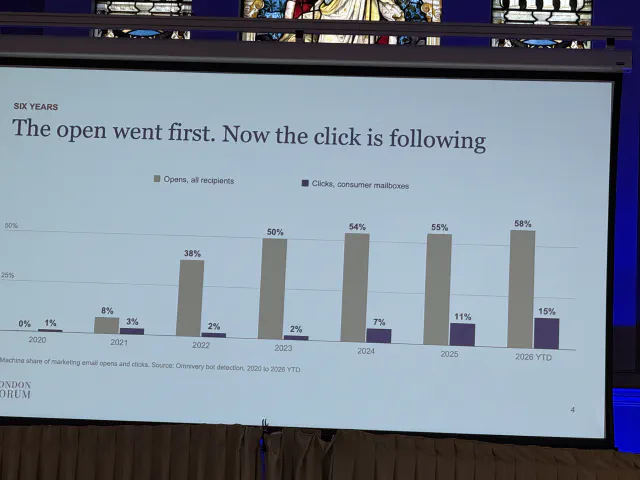
Marketers saw a boom in opens due to COVID. Uh, no, due to Apple MPP.
February, Gmail NHI clicks went from 5% to 20+%. Haven’t come back down, it’s the new baseline.
The worse your reputation the more NHI scans you’ll see.
Business and consumer mailboxes are different.
In business inboxes 62% of NHI clicks a human never clicked.
Unsub and confirm links get NHI clicked. Don’t do single click.
Follow-up segmentation based on opens go to people who never saw the original mail.
Seed, monitoring and archive addresses look like best readers, as each time a user looks at the archive of mails it looks like more engagement.
Newsletter monetized ad network - 86% of paid ad clicks are fraud bots.
If opens and clicks are both mostly machines, what are we actually optimising for?
MPP nerfed our ability to measure, but it wasn’t good before then. People are weird - images blocked, users reading mail and opening browser manually. EU legislation changes compromise open data.
Marketers using MPP as a reliable sign of inbox placement, using as 2-3 year window channel metrics to make decisions. Going to do much the same with clicks - it’s all data.
Need to look beyond email channel metrics to see what’s happening. How is customer engaging on site / app. Recognize the newsletter value beyond direct clicks.
All channels working together, but also cannibalizing each other. Moving subscribers around.
Look at the big picture.
There’s a long way to go to get what we want, but we’re moving beyond just email metrics.
we’re CRM marketers, more than email marketers
How do we detect a spam problem in B2B. Gotta tease out the signal from the noise, drilling down to the bottom of the funnel to see how the customer is being affected.
Got to get comfortable with not seeing what’s really happening, get used to proxy measurements / ESP massaged numbers.
Extrapolated numbers can be very misleading, exist to make C-level happy. Using old practices based on extrapolated numbers misleading. Also often massaged to make the customer happy rather than bringing value.
Better to be honest and to understand the actual data and change your behaviour to be based on that.
Are you trying to say marketers cook their books to look good to the C suite?
You’re always making assumptions, you have to try to make good ones.
Get some data. Prove or disprove your assumptions. Extrapolation doesn’t work that way.
Non-real time reporting on broader trends can be done reasonably accurately using AI. But if you don’t have accurate data the models will screw up.
Does anyone think that every real human click is actually meaningful?
Audience: no hands up
In aggregate the signal adds up and is meaningful. Individual behaviour never was entirely useful. So maybe things haven’t changed that much.
Various things you can derive from MPP opens. Mailbox active, device on charger. Location is more accurate than non MPP geolocation.
MPP potentially more useful than other signals for recipient existence.
Lots of different types of NHI clicks, agents, security, malware, …
Delivery fell off a cliff. What do you do next?
Interesting walkthrough of a delivery issue that ended up being that the .mil administrators had blocked OVH’s entire ASN.
Neat sidenote that each US Navy submarine runs its own exchange server, and surfaces to connect every two months. So there are some long, long queue timeouts pointing at those domains.
Bring the deliverability case nobody has solved
That was fun. Lots of audience participation, but I was running the panel and didn’t record the snark.
When AI reads the email before the customer does
Back in the 2000s we created the open rate to con three martini lunch marketers to sign on with email. We thought it would die. Skip created the fantasy of the “open rate” and he’s really sorry.
If AI decides what’s interesting to show to the user, how can you influence that?
The AI will read it like a user, so there’s nothing special to do.
The AI will not (currently) learn what the user likes. It’s just text summarization.
Marcel: AI has been reading your mail for a decade, to do spam filtering and to extract structured data to give the best user experience.
AI in email should be a means to an end.
Users distrust AI summaries, and often dislike them. Product challenge to actually improve things, not just shove AI in.
We’re all working together to get the end user what the end user wants
Structured metadata in email makes AI summaries less bad.
Lot’s of discussion about summaries and search and people being trained to rely on the first result.
In email the summary isn’t necessarily trusted, so you have to read the mail too and see if they’re the same. More work. A summary of a newsletter isn’t helpful - the newsletter is the product.
Using it to reduce work for the customer is better, and could work better in marketing mails. The summary (or the extra widgets) let the user get to conversion faster.
Is there a risk of writing for the algorithm rather than the consumer? No, write for the consumer - and if it’s relevant to the recipient the AI will (hopefully) amplify it to the recipient. Let the customer see what’s relevant to them, make it easy to consume and move to an action.
keep sending those boring well designed emails for humans, not for the machine
… but adding structured data that matches the content can help.
Don’t try and trick the machine.
With mailbox content being treated as a data repository for AI powered search the right mail sent a year ago and found by search may be as relevant as one today.