Whois silliness from Tucows

In the wake of GDPR, public whois records are 100% redacted. There is lots of work going on to attempt to provide the data without violating privacy laws, but no one is there yet.

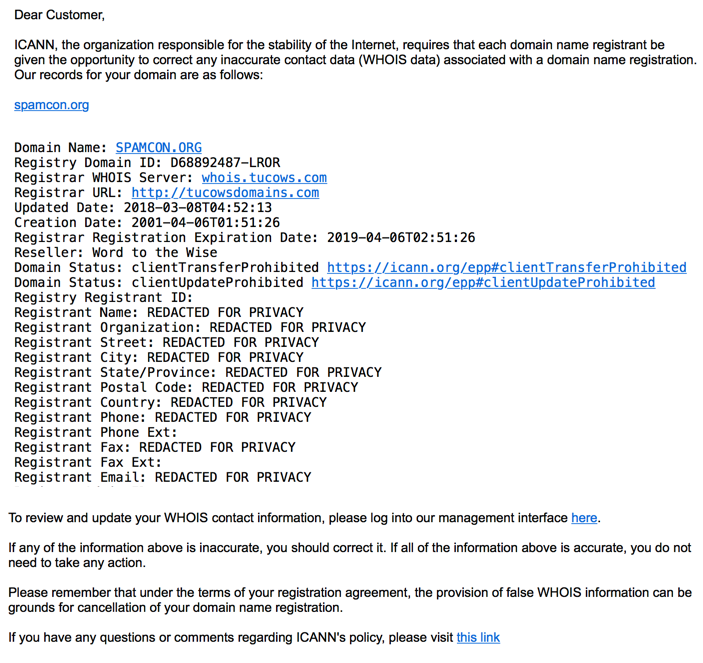
This came up because today I got email from Tucows asking  me to verify and, if necessary, update my whois data. Now, Tucows is the registrar, so they know all of the data. But they sent me thisGee, thanks. That’s so helpful.
Related Posts

Whois privacy protection

I’ve talked about using privacy protection on domains in the past (here, here, here, here, and here). Short version (if you don’t want to check all the old links) is that privacy protection for commercial domains is bad, that’s what spammers do and legitimate email marketers should not hide domains behind privacy protection services. I still believe all of these things.
What I’ve never really addressed is that I think privacy protection services are appropriate in some cases and are a reasonable protective measure for individuals.  Over on Spamresource, Al wrote up a great post today about whois privacy protection.
Sometimes people do need anonymity and privacy online. Trusting a registrar’s privacy protection service is probably not your best bet for that. Like Al, we’ve stood in as a “privacy service” for friends and colleagues. It was our name on the domain registrations, and we could contact the appropriate people as needed. They trusted us to forward only the important stuff and we trusted them not to do bad things. This trust doesn’t scale.
Privacy protection services are used by a lot of bad actors to hide their involvement. Companies and commercial entities are tarring their own reputations using privacy protection services.
No real pull quote here, all of Al’s points are too good. So go read the whole thing.
 

Read More

UCEProtect and GDPR fallout

First thing this morning I got an email from a client that they were listed on the UCEProtect Level 3 blacklist. Mid-morning I got a message from a different client telling me the same thing. Both clients shared their bounce messages with me:

Read More

Transparency in sending

Al has a post listing some of the bad things some sender representatives do when approaching ISPs for delisting.
One of the things I would add to the list is hiding behind a privacy protected domain registration. No matter how you dice it, having a business domain behind privacy protection makes a company look illegitimate. For any company sending commercial mail, it’s not even an issue as senders are required by law to include an address in every email. With this sort of requirement, it’s not like customers aren’t going to be able to find them.
This is an issue I feel so strongly about, I will not represent senders to ISPs unless they have a valid, unprotected whois registration. I do offer consulting and other services to them, but will not contact the ISPs on their behalf. This is not the reputation I want to create with the ISPs for myself or my other clients.
I challenge anyone who is running a business and using a whois privacy protection service to put the same address in their whois record as is on every email you send out.
I challenge ISPs to stop offering whitelisting, FBL or other services to senders who insist on using whois privacy services.

Read More