Whois silliness from Tucows

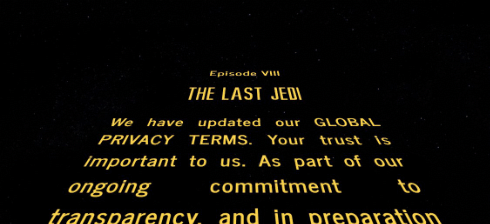
In the wake of GDPR, public whois records are 100% redacted. There is lots of work going on to attempt to provide the data without violating privacy laws, but no one is there yet.

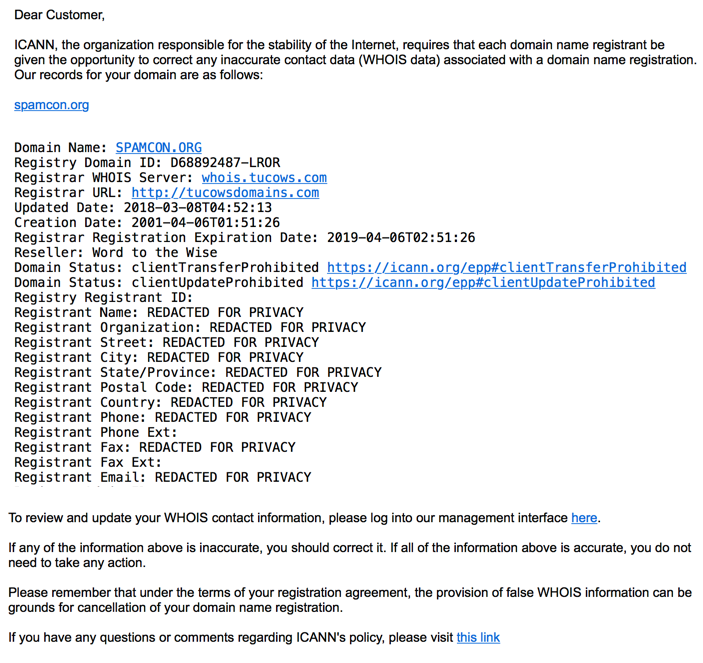
This came up because today I got email from Tucows asking  me to verify and, if necessary, update my whois data. Now, Tucows is the registrar, so they know all of the data. But they sent me thisGee, thanks. That’s so helpful.
Related Posts

Whois privacy protection

I’ve talked about using privacy protection on domains in the past (hereherehere, here, and here). Short version (if you don’t want to check all the old links) is that privacy protection for commercial domains is bad, that’s what spammers do and legitimate email marketers should not hide domains behind privacy protection services. I still believe all of these things.
What I’ve never really addressed is that I think privacy protection services are appropriate in some cases and are a reasonable protective measure for individuals.  Over on Spamresource, Al wrote up a great post today about whois privacy protection.
Sometimes people do need anonymity and privacy online. Trusting a registrar’s privacy protection service is probably not your best bet for that. Like Al, we’ve stood in as a “privacy service” for friends and colleagues. It was our name on the domain registrations, and we could contact the appropriate people as needed. They trusted us to forward only the important stuff and we trusted them not to do bad things. This trust doesn’t scale.
Privacy protection services are used by a lot of bad actors to hide their involvement. Companies and commercial entities are tarring their own reputations using privacy protection services.
No real pull quote here, all of Al’s points are too good. So go read the whole thing.
 

Read More

GDPR and the EU and Opt-in Confirmation

There’s a lot of discussion going on about just what GDPR requires, and of who, and in which jurisdictions. German organizations in particular have been more aggressive than most about wanting to see opt-in confirmation for years and now seem to be adding “because GDPR” to their arguments.
I’m still not sure how this is going to shake out, but I’m beginning to see list owners take externally visible action.

I’ve been a subscriber for four or five years – it’s a good mailing list, run well, and I doubt it has any delivery issues beyond the unavoidable.
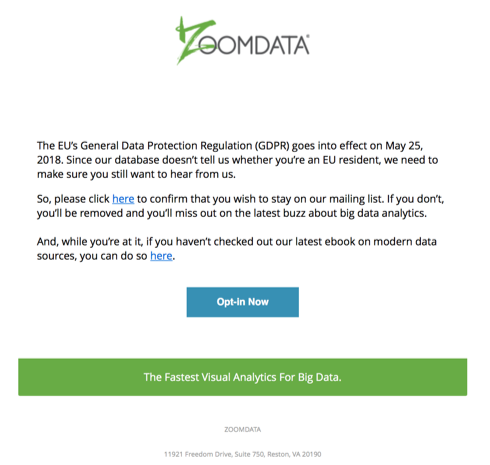
So this is a permission pass solely because they’re not sure whether I’m an EU resident, and aren’t 100% sure their opt-in confirmation data is squeaky clean (I subscribed as part of downloading an app of theirs, but after five years I couldn’t tell you whether that was technically confirmed opt-in or not, and I’m sure they can’t either).
Zoomdata aren’t taking any chances on confirmation. This isn’t a single “click to confirm you want to stay on the list” permission pass, rather it goes to a form that asks whether I’m an EU resident and if I am requires me to check an “Opt-in to email communications” checkbox and then click on a link in a confirmation email.
I’m not an EU resident today but may be an EU resident in the near future – yet my email address won’t change and nor will my mailing list subscriptions. That does make me wonder how valid it is to be capturing opt-in permission solely for recipients who are EU residents today.
Also are non-EU residents likely to claim they live in the EU because they’ll be treated better as far as their privacy is concerned, much the same as telling Facebook or Twitter you live in Germany provides you with better content filters?
I guess I’ll be seeing more of this in my inbox over the next few weeks. How are all y’all handling GDPR compliance?

Read More

I subscribed to what?

Tomorrow is GDPR day. That’s the day when the new Global Data Protection Regulations take effect in the EU. I’m sure everyone reading this blog has seen dozens, if not hundreds, of blog posts, articles, webinars, and guidance docs about how to comply. I’m not going to rehash it because, other folks know this better than me.
There are a some things I’m finding fascinating watching  this whole GDPR thing.
First, the number of companies who have my addresses and I don’t know why. Take Newsweek (yes, the magazine people). They’re sending GDPR notifications to my LinkedIn address. I can’t figure out why they’re harvesting / buying addresses from LinkedIn. Then there’s SALESmango who are some company that started spamming me a few years ago and refuses to accept unsubscribe request. They’re sending me opt-in requests. Yeah, no, go away. I told you to stop, but wow, you won’t.
Another interesting piece is just how much I’ve signed up for over the last 18 – 20 years I’ve been using this set of addresses. Wow. So much mail. And, generally, I thought of myself as relatively careful in who I gave email addresses to. I don’t normally go around dropping addresses into forms but even a couple a month adds up over 20 years.
Then there are the companies violating CAN SPAM in one way or another. Sending mail to unsubscribed addresses and refusing to include an opt-out link are the two things I’ve seen regularly. Yeah, no. I think it’s safe to say that if I’ve opted out from receiving your mail, you should probably put my data away in a dark closet and not touch it again. But.. but.. but… But nothing. Go away. As for the lack of an unsubscribe link, get over yourself. You’re not that special. I don’t think that this really is something that counts for exemption.
Also, is there an official template? So many of these emails look identical. I have to give credit to whomever did it first. Because if plagiarism is the sincerest form of praise, you have an entire industry praising you.
Finally, it’s been amusing to watch the general frustration with all the GDPR mail. It seems many people are getting tired of the deluge. That’s OK, though, it should end by Saturday. Or so we can only hope.
 

Read More