Hitting the ground running

We’ve landed in Dublin and are back at work. Blogging will pick up as I get back into the swing of things.

I’ll be speaking on a panel at the Selligent user conference in Amsterdam tomorrow and in London on Thursday. If you’re a Selligent customer, introduce yourself and say hi!

Speaking of being on panels, I heard recently that some folks were adding conference speakers to newsletter and marketing lists. The scenario was something like this. Person goes to a conference and sees speakers talking about things they’re very interested in. They return to the office and dig around to find email addresses of the speakers. Once they find the email addresses, they add them to the company mailing list.

As a speaker, let me tell you, this is a bad idea. All of us are thrilled you found our talk inspiring, interesting and worth following up on. Follow up with us, absolutely. Don’t add us to your mailing list. Send us an email, introduce yourself, tell us who you and your company are. All of that is great. Love to hear from you, love to hear about the interesting things your doing and how our talks have made you think about your program. Don’t just throw us on your newsletter list.

First off, think of the numbers. Small venues might be a dozen or so people. Larger venues can be in the hundreds. If this catches on, we’ll be swamped with mail.

Secondly, we don’t always know who is in the audience. Adding us to a mailing list without permission just looks like another bit of spam. We don’t know that you added us because you were in the audience. All we know is that your company has started mailing without permission.

Send us a direct email telling us about your company and how our talk impacted you and the company? Absolutely.

Invite us to opt-in to your newsletter so we can follow your company development? Sure. We might not actually do it, but the invite is OK.

Add us to your company newsletter with no warning? Don’t do that. It’s not just rude, it’s spamming.
Related Posts

That's not how you do it…

Got an email this morning from a company advertising their newest webinar “The Two Pillars of Effective Large-Scale Email: Security and Deliverability.” The message came to a tagged address, so clearly I’d given them one at some point. But I didn’t recognize the name or company or anything. I did a search to seen when I may have interacted with this company in the past.

Looking through my old emails, it appears I contacted this company through their support form back in 2007. They were blocking a client’s newsletter. This is what I sent:

Read More

Unsubscribe means unsubscribe

But, unfortunately, some senders don’t actually think unsubscribe means stop sending mail.
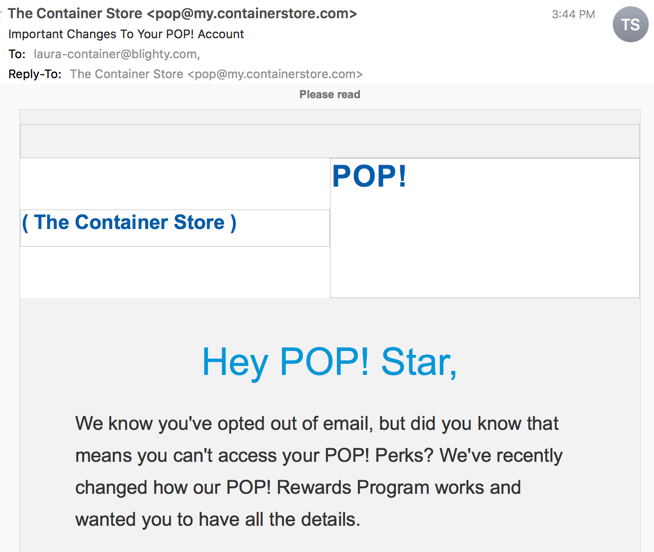
Today, for instance, the nice folks at The Container Store sent me an email with an “important update to my POP! account”

Yes, that’s an address I gave them. But I don’t have any record of setting up an account. I was on their mailing list for all of 4 emails back in November 2016 before unsubscribing. But, they’ve decided they can email me despite my unsubscribe request.
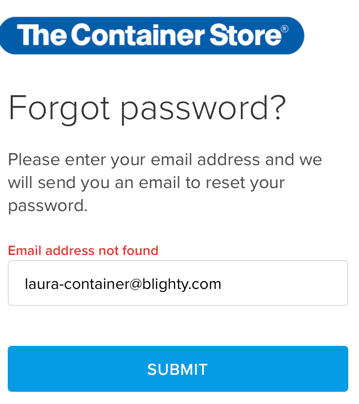
They’ve cloaked this as an “Important Account Update” about some account I don’t have. In fact, when I go to their website and try and see what this oh so important account is about they tell me:


I understand legitimate account notifications might be an acceptable excuse to send mail even after the recipient opted out. This, however, was done extremely poorly. There is no record of the account that they are sending me information about. Neither the company nor I have any record of this account of mine.
At a minimum the emails should have only be sent to the folks that actually had an account. But, they weren’t.
I also have some issues with a company requiring recipients to accept email in order to continue using reward points. As a recipient, if I wanted what they were offering I might go ahead and continue receiving emails. But, I might not. It would all depend on how aggressive their email program is and how good the rewards are. As a deliverability consultant, this strikes me as a great way to create a mailing list full of unengaged users. Unengaged users lead to spam foldering and eventual failure of an email marketing program.
Whatever some executives think, and having been in this industry for a decade and I half I’m sure this is coming from the top down, this is not a good way to build an email program. You really can’t force folks to accept your email. ISPs are too protective of their users to make that a viable strategy.

Read More

Harvesting and forging email addresses

For the contact address on our website, Steve has set up a rotating set of addresses. This is to minimize the amount of spam we have to deal with coming from address harvesters. This has worked quite well. In fact it works so well I didn’t expect that publishing an email address for taking reader questions would generate a lot of spam.
Boy, was I wrong. That address has been on the website less than a month and I’m already getting lots of spam to it. Most of it is business related spam, but there’s a couple things that make me think that someone has been signing that address up to mailing lists.
One is the confirmation email I received from Yelp. I don’t actually believe Yelp harvested my address and tried to create me an email account. I was happy when I got the first mail from Yelp. It said “click here to confirm your account.” Yay! Yelp is actually using confirmations so I just have to ignore the mail and that will all go away.
At least I was happy about it, until I started getting Yelp newsletters to that address.
Yelp gets half a star for attempting to do COI, but loses half for sending newsletters to people who didn’t confirm their account.
I really didn’t believe that people would grab a clearly tagged address off the blog and subscribe it to mailing lists or networking sites. I simply didn’t believe this happened anymore. I know forge subscribing used to be common, but it does appear that someone forge signed me up for a Yelp account. Clearly there are more dumb idiots out there than I thought.
Of course, it’s not just malicious people signing the address up to lists. There are also spammers harvesting directly off the website.
I did expect that there would be some harvesting going on and that I would get spam to the address. I am very surprised at the volume and type of spam, though. I’m getting a lot of chinese language spam, a lot of “join our business organization” spam and mail claiming I subscribed to receive their offers.
Surprisingly, much of the spam to this address violates CAN SPAM in some way shape or form. And I can prove harvesting, which would net treble damages if I had the time or inclination to sue.
It’s been an interesting experience, putting an unfiltered address on the website. Unfortunately, I am at risk of losing your questions because of the amount of spam coming in. I don’t think I’ve missed any, yet, but losing real mail is always a risk when an address gets a lot of spam – whether or not the recipient runs filters.
I’m still pondering solutions, but for now the questions address will remain as it is.

Read More