Back to the office!

I’m back in the office after a busy June. The 2 continent, 3 city tour was unexpectedly extended to a 4th city thus I was out most of last week as well.
What was I doing? We spent a week in Dublin, which is an awesome and amazing city and I love it a little bit more every time we visit. After Dublin I jetted off to Chicago, where I spoke at ActiveCampaign’s first user conference.
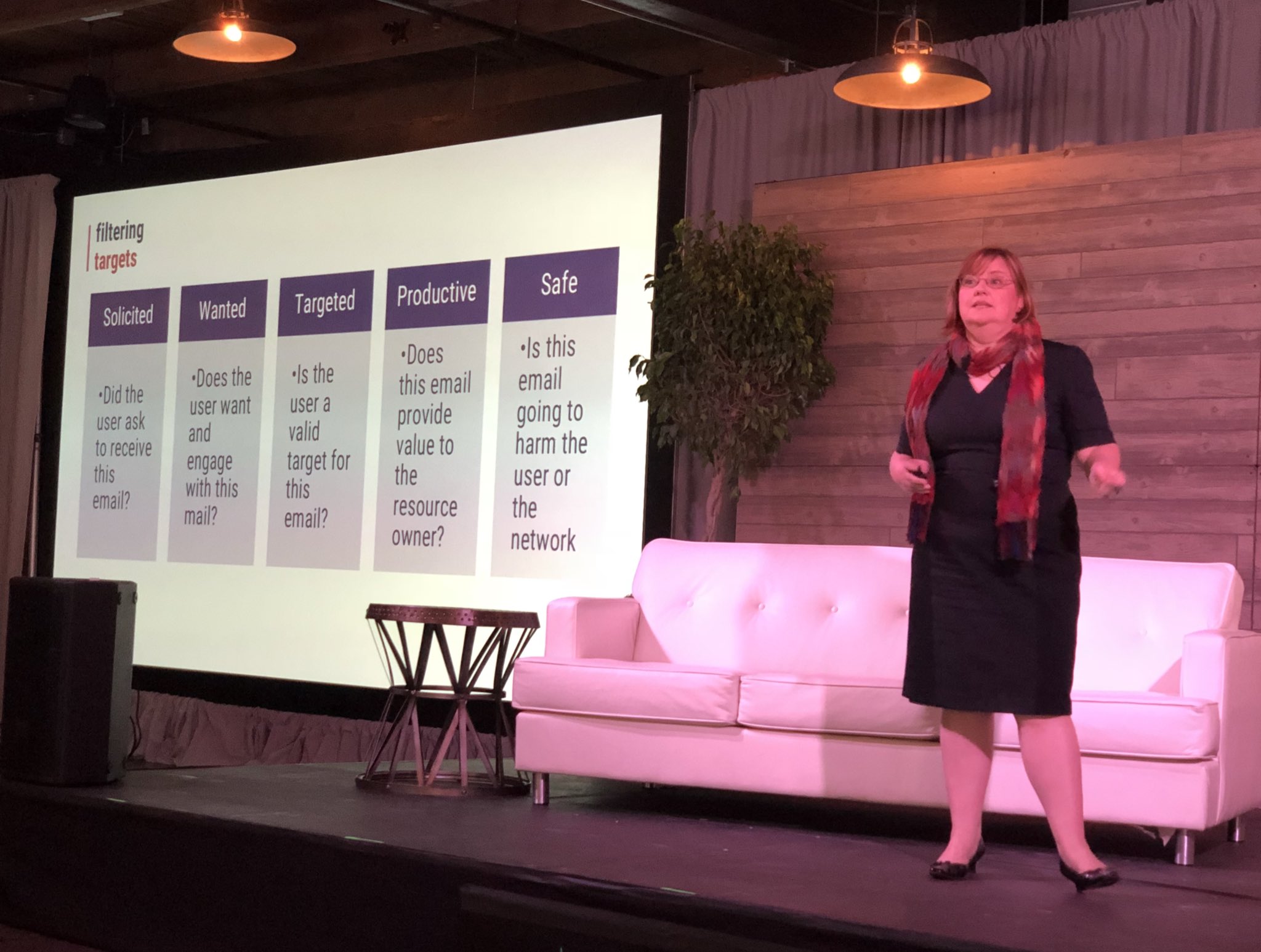
The talk I did for ActiveCampaign was about how we’re in the middle of a fundamental shift in how email is filtered, particularly at the consumer ISPs. In order reach the inbox. we need to think beyond IP or domain reputation. We need to stop thinking of filters as a way of sorting good mail from bad mail. I touched a little on these concepts in my What kind of mail do filters target? blog post.
The shift in filtering is changing how email reaches the inbox and what we can and should be monitoring. At the same time, the amount of data we can get back from the ISPs is decreasing. This means we’re looking at a situation when our primary delivery fixes can’t be based on feedback from the filters. This is, I think, going to be an ongoing theme of blog posts over the next few months.
The next trip was to spend 2 days onsite at a client’s office. These types of onsite training are intense but I do enjoy them. As this was mostly client specific, there isn’t much I can share. They did describe it as a masterclass in deliverability, so I think it was also intense for them.
That was the planned 2 continent, 3 city tour. The last city was a late addition of a more personal nature. We headed downstate to join my cousin and her family in saying goodbye to my uncle. He was an amazing man. A larger than life, literal hero (underwater EOD, awarded the silver star) whom I wish I had known better. Most of what I remember is how much he loved and adored my aunt.
I’ll be getting back into the swing of blogging over the next few days. It’s good to be back and not looking at traveling in the short term.


Related Posts

Thinking about deliverability

I was chatting with folks over on one of the email slack channels today. The discussion was about an ESP not wanting to implement a particular change as it would hurt deliverability. It led me down a path of thinking about how we think of deliverability and how that informs how we approach email.
The biggest problem I see is the black and white thinking.
There’s an underlying belief in the deliverability, receiving, and filtering communities  that the only way to affect sending behavior is to block (or threaten to block) mail.

This was true back in the ancient times (the late 90’s). We didn’t have sophisticated tools and fast CPUs. There weren’t a lot of ways to handle bad mail other than to block. Now the landscape is different. We have many more tools and the computing capacity to quickly sort large streams of data.
At most places these days, blocking is an escalation, not a warning shot. Many places rate limit and bulk folder questionable mail as a first strike against problem mail. Sometimes the mail is bad enough to result in a block. Other times, it’s not bad enough to block, so it disappears into the bulk folder.
There’s a corresponding belief in the sending community that if their behavior doesn’t result in blocking then they’re acting acceptably. This isn’t true either. There are a lot of things you can do (or not do) that don’t help delivery, but will actively harm delivery. Likewise, there are things you can do that don’t actively harm delivery, but will help. All of these things add up to reaching the inbox.

Read More

It's not fair

In the delivery space, stuff comes in cycles. We’re currently in a cycle where people are unhappy with spam filters. There are two reasons they’re unhappy: false positives and false negatives.
False positives are emails that the user doesn’t think is spam but goes into the bulk folder anyway.
Fales negatives are emails that the user does thing is spam but is delivered to the inbox.
I’ve sat on multiple calls over the course of my career, with clients and potential clients, where the question I cannot answer comes up. “Why do I still get spam?”
I have a lot of thoughts about this question and what it means for a discussion, how it should be answered and what the next steps are. But it’s important to understand that I, and most of my deliverability colleagues, hate this question. Yet we get it all the time. ISPs get it, too.
A big part of the answer is because spammers spend inordinate amounts of time and money trying to figure out how to break filters. In fact, back in 2006 the FTC fined a company almost a million dollars for using deceptive techniques to try and get into filters. One of the things this company did would be to have folks manually create emails to test filters. Once they found a piece of text that would get into the inbox, they’d spam until the filters caught up. Then, they’d start testing content again to see what would get past the filters. Repeat.
This wasn’t some fly by night company. They had beautiful offices in San Francisco with conference rooms overlooking Treasure Island. They were profitable. They were spammers. Of course, not long after the FTC fined them, they filed bankruptcy and disappeared.
Other spammers create and cultivate vast networks of IP addresses and domains to be used in snowshoeing operations. Still other spammers create criminal acts to hijack reputation of legitimate senders to make it to the inbox.
Why do you still get spam? That’s a bit like asking why people speed or run red lights. You still get spam because spammers invest a lot of money and time into sending you spam. They’re OK with only a small percentage of emails getting through filters, they’ll just make it up in volume.
Spam still exists because spammers still exist.
 

Read More

Still with the Microsoft problems

We took a quick trip to Dublin last week. I had every intention of blogging while on the trip, but… oops. I did get to meet with some clients, and had a great dinner while discussing email and delivery.

Coming back, I see a lot of folks still reporting delivery problems to Microsoft properties. I’ve been operating under the assumption this was temporary as kinks were worked out after the migration. I’m still pretty convinced not all of the problems are intentional. Even the best tested code can have issues that only show up under real load with real users. Reading between-some-lines tells me that the tech team is hard at work identifying and fixing issues. There will be changes and things will continue to improve.
With all that being said, I think it’s important to realize that delivering to the new system is not the same as delivering to the old system. This is a major overhaul of their email handling code, representing multiple years worth of planning and development inside Microsoft. It’s very likely that not all of the current delivery problems are the result of deployment. Some of the problems are likely a result of new standards and thresholds for reaching the inbox. What worked a year ago to get into the inbox just doesn’t any more.

Read More