Google Postmaster bad IP reputation

There are widespread reports this morning (9/11/17) that Google postmaster tools is showing bad IP reputation for IPs starting on 9/9. This issue is affecting just about everyone. Looking through my client’s postmaster pages, I’m seeing red for IP reputation on every client. Even my clients with generally good reputation are seeing bad reputation since 9/9. 
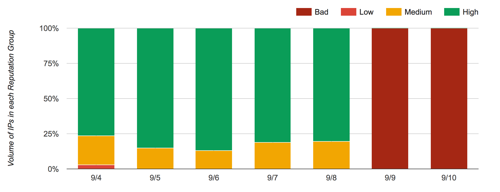
This looks like a reporting or a display error on the part of Google. Many people who are reporting the bad IP reputation are not seeing any significant change in Gmail deliverability.
Looking through client data it appears that domain reputation reporting stopped on 9/8. I am seeing FBL reports for 9/9 and 9/10, for some but not all clients.
My current read on the situation is that something broke internally with the Gmail postmaster reporting. This does not currently appear to be affecting delivery of mail. (If anyone sees differently, drop me an email or tweet me @wise_laura).
I know folks are making sure Google knows. I know that some Gmail folks were directly notified and another Google person is active on Mailop. And we have confirmation that they are aware and are working on fixing it. I will let you know if I hear of a fix timeline.
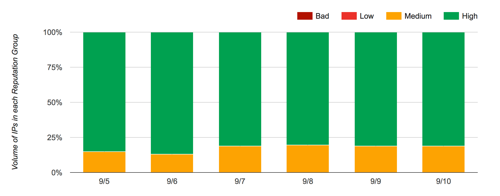
EDIT: It’s been fixed. Google even fixed the older data. Same client, screenshot from this morning.
 

Related Posts

Sharing access to Google Postmaster Tools

As a delivery consultant, I always ask clients to share their Google postmaster reports with me. As Gmail is one of the bigger delivery challenges for a lot of senders, having access to the postmaster tools helps tease out issues. I had some issues earlier this week getting access to tools and so brought up a conversation on one of the delivery lists. The nice folks there helped me get it solved.
A few hours later someone asked me how do I get access and I thought that was a brilliant idea for a blog post today.

Read More

Active buttons in the subject line

This morning I waded into a twitter discussion with a bunch of folks about some issues they were having with delivery to gmail. The discussion started with a blog post at detailed.com describing how some senders are seeing significant drops in open rates. I thought I’d take a look and see if I can help, because, hey, this is an interesting problem.
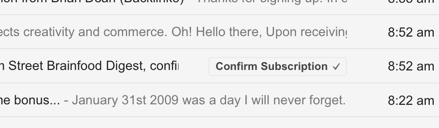
I signed up for a bunch of the mail that was seeing gmail problems and discovered that one of them had the confirmation link in the subject line. How cool is that?

I’ve known about the Gmail subscription line functionality for a while, but this is the first time I’ve seen it in the wild.
The action is in a <div> tag at the bottom of the email. Gmail has been allowing actions in subject lines for a while, this is just the first time I’ve seen it used for subscriptions. It’s so cool.
Want to add one to your post? Instructions are available from Google on their Email Markup pages.

Read More

Google Postmaster Tools

Earlier this month Google announced a new set of tools for senders at their Postmaster Tools site. To get into the site you need to login to Google, but they also have a handy support page that doesn’t require a login for folks who want to see what the page is about.
We did register, but don’t send enough mail to get any data back from Google. However, the nice folks at SendGrid were kind enough to share their experiences with me and show me what the site looked like with real data, when I spoke at their recent customer meeting.
Who can register?
Anyone can register for Google Postmaster tools. All you need is the domain authenticated by DKIM (the d= value) or by SPF (the Return Path value).
Who can see data?
Google is only sharing data with trusted domains and only if a minimum volume is sent from those domains. They don’t describe what a trusted domain is, but I expect the criteria include a domain with some history (no brand new domains) and a reasonable track record (some or all of the mail is good).
For ESPs who want to monitor all the mail they send, every mail needs to be signed with a common d= domain. Individual customers that want their own d= can do so. These customers can register for their own access to just their mail.
ESPs that want to do this need to sign with the common key first, and then with the customer’s more selective key.
How does it work?
Google collects data from DKIM and/or SPF authenticated mail, aggregates it and presents it to a Google user that has authenticated the domain.
How do I authenticate?

Read More