Marketing automation plugins facilitate spam

There’s been an explosion of “Google plugins” that facilitate spam through Gmail and G Suite. They have a similar set of features. Most of these features act to protect the spammer from spam filtering and the poor reputation that comes from purchasing lists and incessantly spamming targets. Some of these plugins have all the features of a full fledged ESP, except a SMTP server and a compliance / deliverability team.
I’ll give the folks creating these programs credit. They identified that the marketers want a way to send mail to purchased lists. But ESPs with good deliverability and reputations don’t allow purchased lists. ESPs that do allow purchased lists often have horrible delivery problems. Enter the spam enabling programs.
From the outside, the folks creating these programs have a design goal to permit spam without the negatives. What do I mean? I mean that the program feature set creates an environment where users can send spam without affect the rest of their mail.
The primary way the software prevents spam blocking is using  Google, Amazon or Office 365 as their outbound mail server. Let’s be frank, these systems carry enough real mail, they’re unlikely to be widely blocked. These ISPs are also not geared up to deal with compliance the same way ESPs or consumer providers are.
There seem to be more and more of these companies around. I first learned of them when I started getting a lot of spam from vaguely legitimate companies through google mail servers. Some of them were even kind enough to inform me they were using Gmail as their marketing strategy.
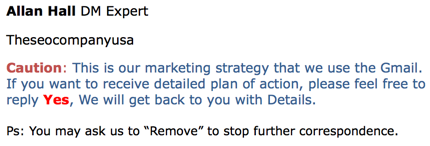
I didn’t realize quite how big this space was, though. And it does seem to be getting even bigger.
Then a vendor in the space reached out looking for delivery help for them and their customers. Seems they were having some challenges getting mail into some ISPs. I told them I couldn’t help. They did mention 3 or 4 names of their competitors, to help me understand their business model.
Last week, one of the companies selling this sort of software asked me if I’d provide quotes for a blog article they were writing. This blog article was about various blocklists and how their software makes it such that their customers don’t really have to worry about blocking. According to the article, even domain based blocking isn’t an issue because they recommend using a domain completely separate from their actual domain. I declined to participate. I did spend a little time on their website just to see what they were doing.
This morning a vendor in the space joined one of the email slack channels I participate in asking for feedback on their software. Again, they provide software so companies can send spam through google outbound IPs. Discussions with the vendor made it clear that they take zero responsibility for how their software is used.
I don’t actually expect that even naming and shaming these companies facilitating spam will do anything to change their minds. They don’t care about the email ecosystem or how annoying their customers are. About the best they could do is accept opt-out requests from those of us who really don’t want to be bothered by their customers. Even that won’t really help, even domain based opt-outs are ineffective.
What needs to happen is companies like Google, Amazon and Microsoft need to step up and enforce their anti-spam policies.

Gmail: You agree not to, and not to allow third parties or Your End Users, to use the Services: to generate or facilitate unsolicited bulk commercial email;

Office 365: When using Microsoft Online Services, you may not:  […] Use the Services to transmit, distribute, or deliver any unsolicited bulk or unsolicited commercial e-mail (i.e., spam)

Amazon: You will not distribute, publish, send, or facilitate the sending of unsolicited mass e-mail or other messages, promotions, advertising, or solicitations (like “spam”), including commercial advertising and informational announcements. You will not alter or obscure mail headers or assume a sender’s identity without the sender’s explicit permission. You will not collect replies to messages sent from another internet service provider if those messages violate this Policy or the acceptable use policy of that provider.

Ideally, the folks providing these services will have all the tools regular ESPs do. I’m sure many of them do have a subset of those tools. But whether or not these issues are big enough to notice or deal with – as opposed to the other outbound issues they have to deal with – remains to be seen.
Of course, if the issues are big enough, the ISPs will take action and quickly. For instance, last week a poster on mailop pointed out Microsoft was the #1 spam ISP on Spamhaus’ list. A MS rep on the list responded and said they were notifying the appropriate people. This morning when I looked in preparation for this post, Microsoft was #1. When I just went to go get a screenshot, Microsoft wasn’t on the list any longer.
I know many people in the anti-abuse space are working on messaging abuse of the future. Calendar invites are one of the emerging issues. I just hope they don’t forget to address this B2B spam that goes out of its way to hide from current anti-spam services and technology.

Related Posts

Parasites hurt email marketing

As a small business owner I am a ripe target for many companies. They buy my address from some lead generation firm, or they scrape it off LinkedIn, and they send me a message that pretends to be personalized but isn’t really.
“I looked at your website… we have a list of email addresses to sell you.”
“We offer cold calling services… can I set up a call with you?”
“I have scheduled a meeting tomorrow so I can tell you about our product that will solve all your technical issues and is also a floor wax.”
None of these emails are anything more than spam. They’re fake personalized. There’s no permission. On a good day they’ll have an opt out link. On a normal day they might include an actual name.
These are messages coming to an email address I’ve spent years trying to protect from getting onto mailing lists. I don’t do fishbowls, I’m careful about who I give my card to, I never use it to sign up for anything. And, still, that has all been for naught.
I don’t really blame the senders, I mean I do, they’re the ones that bought my address and then invested in business automation software that sends me regular emails trying to get me to give them a phone number. Or a contact for “the right person at your business to talk to about this great offer that will change your business.”
The real blame lies with the people who pretend that B2B spam is somehow not spam. Who have pivoted their businesses from selling consumer lists to business lists because permission doesn’t matter when it comes to businesses. The real blame lies with companies who sell “marketing automation software” that plugs into their Google Apps account and hijacks their reputation to get to the inbox. The real blame lies with list cleansing companies who sell list buyers a cleansing service that only hides the evidence of spamming.
There are so many parasites in the email space. They take time, energy and resources from large and small businesses, offering them services that seem good, but really are worthless.
The biologically interesting thing about parasites, though, is that they do better if they don’t overwhelm the host system. They have to stay small. They have to stay hidden. They have to not cause too much harm, otherwise the host system will fight back.
Email fights back too. Parasites will find it harder and harder to get mail delivered in any volume as the host system adapts to them. Already if I look in my junk folder, my filters are correctly flagging these messages as spam. And my filters see a very small portion of mail. Filtering companies and the business email hosting systems have a much broader view and much better defenses.
These emails annoy me, but I know that they are a short term problem.  As more and more businesses move to hosted services, like Google Apps and Office365 the permission rules are going to apply to business addresses as well as consumer addresses. The parasites selling products and services to small business owners can’t overwhelm email. The defenses will step in first.
 

Read More

Google and Amazon and B2B spam

Many of the operational goals of a commercial spammer aren’t related to email delivery at all, rather they revolve around optimizing ROI and minimizing costs. That’s even more true when the spammer isn’t trying to sell their own product, rather they’re making money by sending spam for other companies.
Most legitimate network providers pay at least lip service to not allowing abusive behaviour such as spam from their networks, so a spammer has to make a few choices about what infrastructure to use to optimize their costs.
They can be open about who they are and what they do, and host with a reputable network provider, and build out mailservers much as any legitimate ESP would do. But eventually they’ll get blacklisted by one of the more reputable reputation providers – leading to little of their mail being delivered, and increasing the pressure on their provider to terminate them. They social engineer their provider’s abuse desk, and drag their feet, and make small changes, but eventually they’ll need to move to another provider. Both the delaying tactics and the finally moving are expensive.
Or they can host with a network provider who doesn’t care about abuse from their network, and do the same thing. But they’ll still get blacklisted and, unlike on a more reputable network, they’re much less likely to get any benefit of the doubt from any reputation providers.
Every time they get blacklisted they can move to a new network provider. That’s easy to do if your infrastructure is virtual machine based and moving providers just involves buying a new hosting account. But as anyone who’s heard the phrase “ramping-up” knows mail from new network space is treated with suspicion, and as they’re continually moving their mail won’t reach the inbox much.
Preemptively spreading the sources of your spam across many different IP addresses on different providers, and sending spam out at low enough levels from each address that you’re less likely to be noticed is another approach. This is snowshoe spam and spam filters are getting better at detecting it.
What to do? In order to get mail delivered to the inbox the spammer needs to be sending from somewhere with a good reputation, ideally intermingled with lots of legitimate email, so that the false-positive induced pain of blocking the mailstream would be worse than their spam. That’s one reason a lot of spammers send through legitimate ESPs. They’re still having to jump from provider to provider as they’re terminated, but now they’re relying on the delivery reputation of the shared IP pools at each new ESP they jump to. But that still takes work to move between ESPs. And ESP policy enforcement people talk to each other…
As a spammer you want your mail to be sent from somewhere with good reputation, somewhere you can use many different accounts, so your spam is spread across many of them,  flying below the radar. Ideally you wouldn’t have any documented connection to those accounts, so your activity won’t show up on any aggregated monitoring or reporting.
If nothing in the mail sent out identifies you there is nowhere for recipients to focus their ire. And if recipients can’t tell that the hundreds of pieces of spam in their inbox came from a single spammer, they’re much less likely to focus efforts on blocking that mail stream.
Over the past couple of years I’ve seen a new approach from dedicated B2B spammers, the sort who sell “buy and upload a list, blast out something advertising your company, track responses, send multiple mails over a series of weeks” services to salespeople. They’re the ones who tend to have glossy, legitimate websites, talking about “lead nurturing”, “automated drip campaigns” or “outreach automation”.
They have each of their customers sign up for gmail or google apps accounts, or use their existing google apps accounts, and then the spammer funnels the spam sent on behalf of that customer through that google account. There’s no obvious connection between the spammer and the google account so there’s no risk to the spammer. Google is fairly unresponsive to spam complaints, so as long as the volume sent by each customer isn’t spectacularly high it’s going to be well below Google automation’s threshold of notice.
Google do record where mail that’s injected into their infrastructure in this way comes from, in the Received headers. But the spammers run their sending infrastructure – list management, message composition, tracking and so on – on anonymous, throwaway virtual machines hosted on Amazon’s EC2 cloud, so there’s nothing in the email that leads back to the spammer.
And, for recipients, that’s a problem. Spam filters aren’t going to block this sort of mail, as they can’t easily tell it is this sort of mail. It’s coming from Google MTAs, just like a lot of legitimate mail does. In terms of sheer volume it’s dwarfed by botnet sourced mail or dubious B2B manufacturing spam out of Shenzhen. But, unlike most of that, it’s in your inbox, in front of your eyeballs and costing you time and focus. And that’s much more expensive than network infrastructure or mailbox storage space.
I’m not sure what, if anything, Google or Amazon can do about it at scale, but it’s something that’s going to need to be dealt with eventually.
Meanwhile, if you receive some marginally personalized mail from a sales rep, one attempting to look like 1:1 mail, look at the headers. If you see something like this …

Read More

Blocking of ESPs

There’s been quite a bit of discussion on my post about upcoming changes that ESPs will be facing in the future. One thing some people read into the post is the idea that ISPs will be blocking ESPs wholesale without any regard for the quality of the mail from that company.
The idea that ESPs are at risk for blocking simply because they are ESPs has been floating around the industry based on comments by an employee at a spam filter vendor at a recent industry conference.
I talked to the company to get some clarification on what that spam filtering company is doing and hopefully to calm some of the concerns that people have.
First off, and probably most important, is that the spam filtering company in question primarily targets their service to enterprises. Filtering is an important part of this service, but it also handles email archiving, URL filtering and employee monitoring. The target market for the company is very different than the ISP market.
The ISPs are not talking about blocking indiscriminately, they are talking about blocking based on bad behavior.
Secondly, this option was driven by customer request. The customers of the spam filtering appliance were complaining about “legitimate” mail from various ESPs. Despite being reasonable targeted the mail was unrequested by the recipient. While ESPs use FBLs and other sources of complaints to clean complainers off rented or epended lists at ISPs, the option is not available for mail sent to corporations. Enterprises don’t, nor should they have to, create and support FBLs. Nor should employees be expected to unsubscribe from mail they never requested.
This option is the direct result of ESPs allowing customers to send spam.
Thirdly, this option is offered to those customers who ask for it. It is not done automatically for everyone. The option is also configurable down to the end user.
While I haven’t seen the options, nor which ESPs are affected, I expect that the ones on the list are the ones that the filtering vendor receives complaints about. If you are not allowing your customers to send spam, and are stopping them from buying lists or epending, then you probably have not come to the attention of the filtering company and are not on the list of ESPs to block.

Read More