Active buttons in the subject line

This morning I waded into a twitter discussion with a bunch of folks about some issues they were having with delivery to gmail. The discussion started with a blog post at detailed.com describing how some senders are seeing significant drops in open rates. I thought I’d take a look and see if I can help, because, hey, this is an interesting problem.
I signed up for a bunch of the mail that was seeing gmail problems and discovered that one of them had the confirmation link in the subject line. How cool is that?
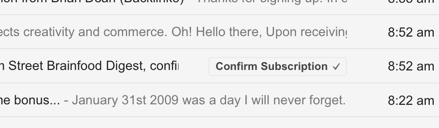
I’ve known about the Gmail subscription line functionality for a while, but this is the first time I’ve seen it in the wild.
The action is in a <div> tag at the bottom of the email. Gmail has been allowing actions in subject lines for a while, this is just the first time I’ve seen it used for subscriptions. It’s so cool.
Want to add one to your post? Instructions are available from Google on their Email Markup pages.
Related Posts

Truth of Consequences

“If you want to use another means that violates the law, and every common definition of “spam”, then by all means, go ahead. You can enjoy fines and being added to the ROKSO database,” says a comment on my recent COI blog post. It’s both disconcerting and entirely predictable.

My post was a discussion of what to do with addresses that don’t confirm. Data tells us that there is some value in those addresses – that there are people who won’t confirm for some reason but will end up purchasing from an email. Using COI leaves some fraction of revenue on the table as it were. My post was a short risk analysis of things to think about when making decisions about continuing to mail to people who don’t confirm.
Mentioning COI often brings the only-COI-mail-is-not-spam zealots out of the woodwork, as it did in this case. In this case, we have the commenter first asserting that failure to do COI is a violation of CAN SPAM (it’s not). When this was pointed out, he started arguing with two people who have been actively fighting spam for 20 years (including running a widely used blocklist). Finally, he ends up with the comment asserting that anyone not using COI will end up on ROKSO. It’s as if he thinks that statement will fear other commenters into not having opinions. It can’t because everyone in the discussion, except possibly him, knows that it’s not true.
The worst problem with folks like the commenter is that they think asserting horrible consequences will make people cower. First off, people don’t react well to threats. Secondly, this is a hollow threat and most people reading this blog know it.
There are millions of mailing lists not using COI and have zero risk of ever getting on ROKSO. The only thing hollow threats do is make people not pay attention to what you have to say. Well, OK, and have me write a blog post about how those threats are bad because they’re completely removed from reality.
Exaggerating or lying about consequences is not just wrong, it’s stupid. “Do this or else BAD THING,” is awesome, up until someone decides they’re not going to do this and the bad thing never happens. It makes people less likely or pay any attention to you in the future. It certainly means your opinions and recommendations are not going to be listened to in the future.
I probably go too far the other direction. I can spend too much time contextualizing a recommendation. It’s one of the things I’m trying to get better about. No, client doesn’t need a 4 page discussion of the history of whatever, they just need 2 lines of what they should do. If they need the context, I can provide it later.
In order to effectively modify behavior consequences have to be real. Threats of consequences are meaningless. Any toddler knows this, and can quite accurately model when mom means it and when she’s just threatening.
Risk analysis is not about modifying behavior. It’s about analyzing a particular issue and providing necessary information so the company action understands potential consequences and the chance those risks will happen. The blog post about COI was not intended to modify anyone’s behavior. I know there are companies out there successfully maintaining two mail streams: one COI and one not. I know there are other companies out there successfully mailing only single opt-in mail. I know there are companies with complex strategies to verify identity and address ownership. And I smile every time I walk into a retail store and they ask me if my email address is still X and if I want to make any changes to it.
Lying about consequences does nothing to modify behavior. All it does is diminish the standing and audience of the liar. Be truthful about the consequences of an action or lack of action. Don’t make up threats in order to bully people into doing what you think is right. Sooner or later they’re going to realize that you don’t know what you’re talking about and start to ignore you.

Read More

The cycle goes on

Monday I published a blog post about the ongoing B2B spam and how annoying it is. I get so many of these they’re becoming an actual problem. 3, 4, 5 a day. And then there’s the ongoing “drip” messages at 4, 6, 8, 12 days. It is getting out of control. It’s spam. It’s annoying. And most of it’s breaking the law.
But, I can also use it as blog (and twitter!) fodder.

Read More

Confirmation is too hard…

One of the biggest arguments against confirmation is that it’s too hard and that there is too much drop off from subscribers. In other words, recipients don’t want to confirm because it’s too much work on their part.
I don’t actually think it’s too much work for recipients. In fact, when a sender has something the recipient wants then they will confirm.
A couple years ago I was troubleshooting a problem. One of my client’s customer was seeing a huge percentage of 550 errors and I was tasked with finding out what they were doing. The first step was identifying the source of the email addresses. Turns out the customer was a Facebook app developer and all the addresses (so he told me) were from users who had installed his apps on Facebook. I did my own tests and couldn’t install any applications without confirming my email address.
Every Facebook user that has installed an application has clicked on an email to confirm they can receive email at the address they supplied Facebook. There are over 1 billion users on Facebook.
Clicking a link isn’t too hard for people who want your content. I hear naysayers who talk about “too hard” and “too much drop off” but what they’re really saying is “what I’m doing isn’t compelling enough for users to go find the confirmation email.”
This isn’t to say everyone who has a high drop off of confirmations is sending poor content. There are some senders that have a lot of fake, poor or otherwise fraudulent addresses entered into their forms. In many cases this is the driving factor for them using COI: to stop people from using their email to harass third parties. Using COI in these cases is a matter of self protection. If they didn’t use COI, they’d have a lot of complaints, traps and delivery problems.
The next time you hear confirmation is too hard, remember that over 1 billion people, including grandparents and the technologically challenged, managed to click that link to confirm their Facebook account. Sure, they wanted what Facebook was offering, but that just tells us that if they want it bad enough they’ll figure out how to confirm.
HT: Spamresource

Read More