Every Download a Confirmation
- steve
- April 26, 2017
- Best practices
We often talk about confirmed opt-in (aka “closed-loop opt-in” or “double opt-in”) as the gold standard for address acquisition for permission-based mail.
It’s not the only way to gather permission, and in some ways it’s a rather blunt tool that can discourage people from completing a sign-up process if it’s done badly – the confirmation email isn’t sent immediately, it goes to the recipients spam folder, they don’t have any reason to go and look for it, …
When it’s done well, though, it’s excellent.
Tor.com, the site for science-fiction and fantasy operated by publisher Macmillan, just did it very well with an ebook giveaway.
Last year they published Every Heart a Doorway, a novella that won several awards and caused quite a bit of buzz in the SFF community, partly because it’s very good and partly because it’s author, Seanan McGuire, has some serious social media chops. The sequel, Down among the Sticks and Bones, is being released in the next month or two.
Perfect timing for a time-limited giveaway of the first book, tied to signing up for their mailing list.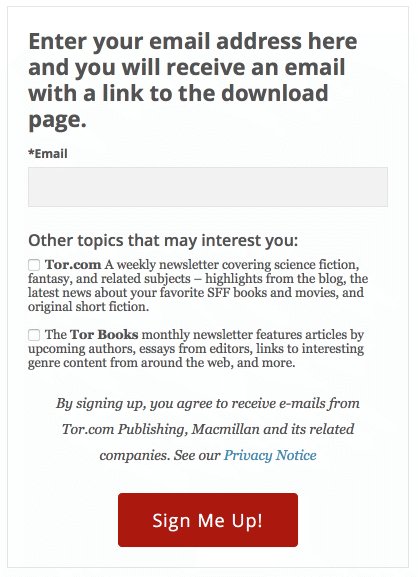
The signup form is on a page dedicated to the giveaway that talks about the book and sets some expectations about the mailing list. The form itself makes it very clear that you’ll need to enter a real email address to get the ebook download, so me@privacy.net is less likely to subscribe.
People aren’t required to sign up for the mailing lists to get the download. This isn’t a barter, a mailing list signup for a book, rather it’s putting the opportunity to sign up for the mailing lists in front of people who are self-selected to be interested in the content. That probably reduces the “how many people signed up” metric somewhat, but I bet the “how many new subscribers are still signed up in a month” numbers will look very healthy.
It provides some options. Do you want weekly content? Monthly? Both? You know that you’re not going to end up on a thrice-daily list from Macmillan and all their affiliates.
The confirmation email landed in my inbox within a few seconds after I clicked the “Sign Me Up” button. That’s important. If it takes even a few minutes I might have moved on, and wouldn’t be looking for the confirmation mail if it had ended up in my bulk folder.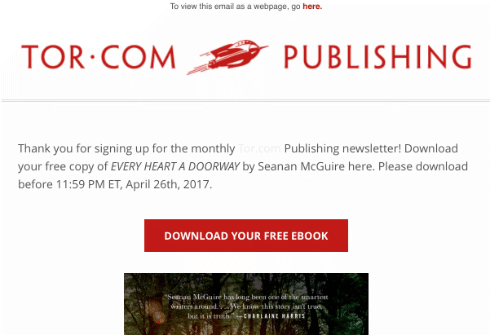
And the confirmation mail isn’t a “click here to confirm your subscription” yawnfest. The subject line is “Download EVERY HEART A DOORWAY by Seanan McGuire Now” and the body content is on-brand and includes the front cover of the book.
Way more compelling.
It’s still solid informed consent from me, and confirmation that I, the owner of the email address, want on the list. (And, yes, the download link has 56 bytes of opaque hex-encoded data in it, so I know they’re tracking that.)
This is how it should be done.
(And, if you like fantasy you should head over to Tor and sign up for their promo. Seanan writes some amazing things, and I’m not just saying that because she’s a friend.)