Doing it right

It’s that time of the year – marketers send more email than usual, recipients unsubscribe from their lists.
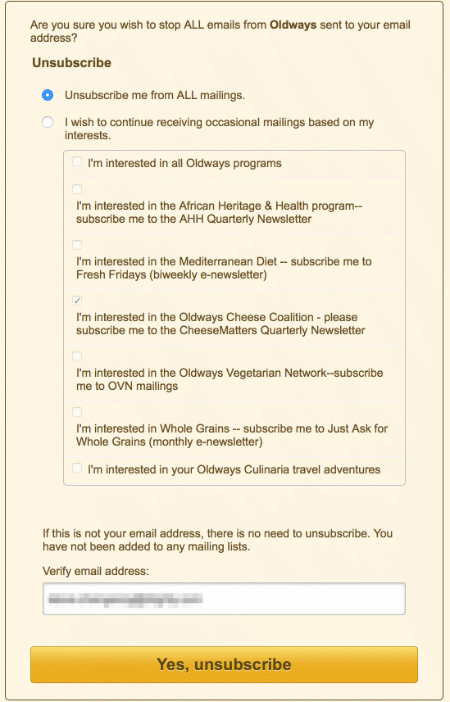
Clicking on the unsubscription link in the email I just received took me to an unsubscription landing page. The box for my email address was prepopulated based on the cookie in the unsubscription link, the default setting is to unsubscribe me from all mail from the sender and just clicking the sole button on the page will unsubscribe me.
It offers me an alternative to unsubscribing from everything – letting me receive just the content I want. It does that immediately on the unsubscription landing page (rather than suggesting I go to a subscription center or, worse, requiring I click on a different link in the mail originally). And it tells me the important things about the newsletters I might want to subscribe to – what they’re about and how often they’re sent.
oldways
This isn’t anything particularly special, but sometimes it’s nice to highlight someone who is doing it right.

Related Posts

August 2014: The Month in Email

Isn’t August the month where things are supposed to slow down? We’re still waiting for that to happen around here… it’s been great to be busy, but we’re hoping to continue to carve out more time for blogging as we move into the fall.
August
As usual, we reported on a mix of industry trends and news, the persistence of spam, and did a deep dive into an interesting technical topic. Let’s start there: Steve wrote a post explaining Asynchronous Bounces (yes, it’s a GNFAB), with some examples of how they’re used and how they can cause operational problems.
In industry news, we did a roundup post of some Gmail changes and a followup post on security issues with non-Latin characters in addresses. We also celebrated the long-awaited release of a wonderful resource from MAAWG that I am very proud to have helped author, the white paper Help! I’m on a Blocklist! (PDF link). We receive dozens of these calls every week, and though we are always happy to help people solve urgent delivery crises, we spend most of our consulting time and attention working with people to build sustainable email programs, so this document is a great “self-service” resource for people looking to troubleshoot blocklist issues on their own.
In other industry and MAAWG-related news, we noted that the nomination period for the J.D. Falk award has opened (you have just a few more days, procrastinators) and took a moment to reminisce about our friend J.D. and his incredible contributions to the field.
On the topic of creating, sending, and reading more attractive email, we posted some  resources from Mailchimp and crowdsourcing templates from Send With Us. We also incorrectly reported on a not-actually-new interface from AOL, Alto. Interesting to note that there’s been so little followup from AOL (and almost no post-launch coverage) in the two years since launch.
We also touched on a few myths: email saves trees and low complaint volume is good.
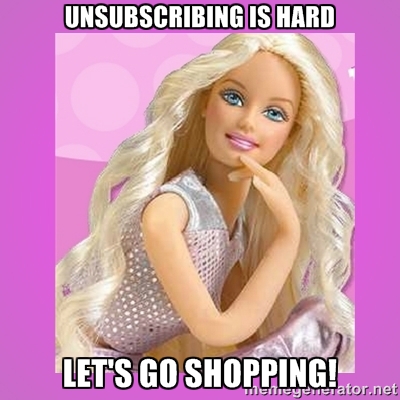
And finally, in November of 2013, I unsubscribed from every possible email I received on a specific account. I followed up on that briefly in a Part 2 post, and this month went back and wrote a Part 3 followup. Spoiler alert: spam is still a problem. Of course, we got some comments that we were probably doing it wrong, so Unsubscribe Barbie showed up to add her thoughts. We try not to be snarky around here, but sometimes we just don’t try very hard.

Read More

Spot the unsub

A new game! Spot the unsub! Our first challenge is the footer from a major software company. How long does it take for you to to find the unsub link?

 
What’s even more annoying is that I never actually subscribed to mail from this company. A few years ago I was doing some work for them and they required I set up an account on their cloud service so they could share docs with me. Last month, they started emailing me as “a customer.” Yeah. No.

Read More

Yes, spam is actually still a problem

I hear a lot of people claim that spam isn’t really a problem any more. That filters are so good that the average user doesn’t see a lot of spam and if they do get “legitimate” mail that they can just opt out.
These are great sounding arguments, the problem is that those arguments aren’t always true.
There is an address I stopped using for commercial mail around 1997 and all mail around 2002. It still gets hundreds of emails a month.
Those hundreds of emails a month are despite the fact that the address is behind commercial spam filters. It’s been on “flamers lists.” It’s on the “do not mail” list that came with the “Millions CD.”
In addition, I am very open with clients (and their affiliates) that this is a “spam trap” address. I’ve handed it out to dozens and dozens of companies over the years describing it as my spam trap address.
In November 2013, I unsubscribed from every single email received at that account – at least those that had unsubscribe links.
What does the mail volume look like now?
MonthlySpamCounts_Smallpng
If anything unsubscribing made the volume problems worse. In the best case it lowered the volume briefly to something approaching 10 emails a day.
There are currently over 500 messages I’ve received so far in August. These are messages advertising companies like Laura Ashley, MetLife, Military.com, Quibids, Walk In Tubs, Sainsbury’s, Bloomburg, Fidelity, Oral B, Lasix Vision Institute, Virgin Broadband, ClickNLoan, Timeshares, iMotors, Walmart, oil changes, Experian, Credit monitoring, Life insurance, ADT, CHW Home Warranty, Health Plans of America, Bosley Hair Solutions, Jillian Michaels Online, restaurant coupons, credit cards, SBA loans, and that’s before we get to the Garcinia cambogia, herbal viagra and clearly fraudulent stuff.
This account, that hasn’t been subscribed to anything in more than 10 years is getting hundreds of unasked for emails a month, even with the benefit of commercial filters. It appears to be being sold or traded in multiple countries (Laura Ashley, Virgin Broadband and Sainsbury’s are all in the UK). I don’t want this mail. I have tried to stop getting this mail.
Yes, spam is still a problem.

Read More