Image Blocking

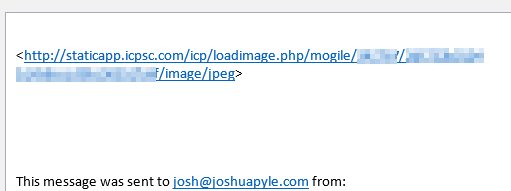
I received this email earlier this week, an email that I wanted but this is how it arrived.
email example 1
The email contained a single image link, a text line of who the message was sent to, the senders name, address, and finally an unsubscribe link.
Good news, the email is CAN-SPAM compliant! Bad news, I have no idea what the content of the message is and it looks somewhat spammy.  The email was sent to my Junk Folder and all images were blocked. As a good netcitizen, we’re trained not to click links if we’re not sure what they are.
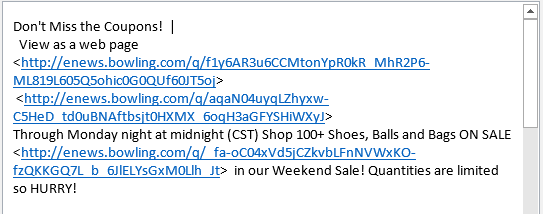
Here is another message I received around that same time and also had the images blocked.  I immediately recognize the domain name, bowling.com and there is text that mentions bowling shoes, balls, and bags. Being an avid bowler, I wanted this message and I will be adding them to my safe senders list in Outlook.
email example 2
The good news for marketers who rely on image based emails is Gmail and many mobile mail clients will auto-load images but there are still many clients that will only display images if the user sets the sender as a trusted sender.  If you are sending a Welcome Message, it’s best to include text along with your images so the recipient can recognize your email and will then add you as a trusted sender.  You can also segment your list by users who are opening the images. The recipients who have not loaded the images would get a different version of the message that includes more text.

Related Posts

Court rules blogger is not a journalist

Last week a federal judge ruled a blogger, Crystal Cox, was not a journalist and not subject to first amendment protections. I haven’t been following the case very closely, but was a little concerned about the precedent and the liability for people like me who blog.
Reading some of the articles on the case, though, I’m less worried. This isn’t a blogger making some statements. Instead, Ms. Cox acted more like a stalker and harasser than a reporter. The judge even concluded that had she been granted protection as a journalist it was unlikely she could prevail as there was little factual basis for her statements.
Others have done better summaries of the case and the effect and I encourage everyone to read them.
Seattle Weekly
New York Times
Ars Technica
Forbes

I also discourage folks from applying this ruling to all bloggers. It’s not clear she was doing anything journalistic. I did find it interesting that some of her techniques to ruin the lawyer’s search results were defined as Search Engine Optimization. I’ve long thought SEO was akin to spam: say something often enough in enough places and you start to dominate the conversation. Not because you have anything useful to say, but because no one can get an idea in otherwise.

Read More

Just stop spamming!

Al posted a clip from the Jim Carrey movie Liar Liar on SpamResource (slightly NSFW) that resonated with me this week.
If you meet me on the street and ask me what my job is I’ll tell you that I work with companies who send bulk email to make sure that they’re not sending spam. I do this by educating clients into good practices and teaching them how to send mail people want to receive. What this statement doesn’t tell people is that usually clients find me because they have been suspended by their ISP for spamming or blocked by some receiver.
Clients who find me because they can’t send mail usually hire me to solve their immediate problem. And I do give the the best advice I can to resolve their problem. But fixing today’s problem isn’t enough, you also need to fix the processes that caused the problem. To me, a critical part of my job is to set clients up for long term success by creating procedures that will get them delisted and keep them from being relisted in the future.
Sometimes, though, I have those moments Al is talking about. When clients don’t actually want to fix their problems, they just want to argue. They want to argue about the definition of spam. They want to argue about permission. They want to argue about how awful their ISPs are for suspending their account. They want to argue about CAN SPAM. They want to argue about free speech. They are angry and they want to fight.
My role is to listen to them, then guide them down a constructive path. I do turn out to be the sounding board for a lot of customers, sometimes they just need to know someone is listening to them. Once they get it all out we can move on into solving the problem.
But, boy, are there the occasional conversations where I just want to scream, “JUST STOP SPAMMING!”

Read More

Links: September 24, 2012

Last week Return Path announce a new set of email intelligence products. One of their new products offers customers the chance to actually see how (some subset of) their customer base interacts with mail directly. It moves beyond simply looking at probe mailboxes and actually looks inside the mailbox of recipients.
Spamhaus has listed bit.ly on the Domain Blocklist (DBL) for allowing spammers to abuse their redirector service. Spammers have been abusing bit.ly for a while, and I’m a little surprised it’s taken so long for a listing to happen. Steve wrote a post last year about URL redirectors and offered suggestions on what to do to avoid blocking problems when using a URL shortening service.
Real Insights has a very interesting post on why it should be “hard” to subscribe to your mailing list. There are also a number of good suggestions about the subscription process itself. Definitely worth a read.

Read More