A good example of 3rd party email

This morning I received a great example of a 3rd party email that I thought I’d share with all of you.
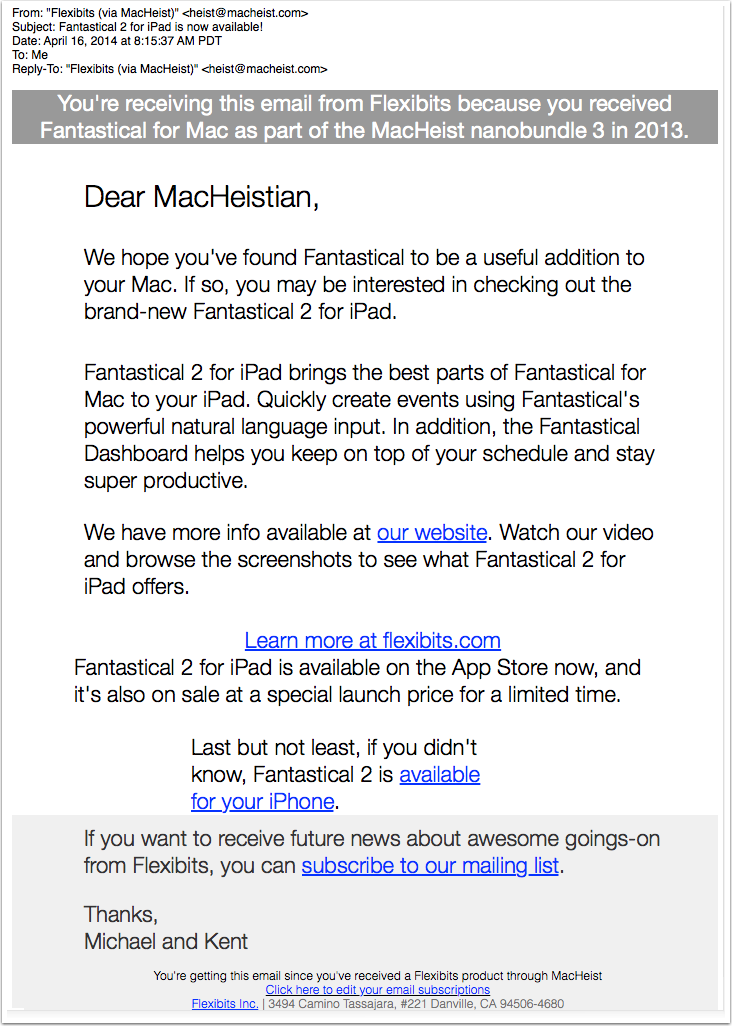
Good3rdPartyEmail
 
What’s so great about it?

  1. It’s sent from the company I actually gave my email address to: Macheist.
  2. It tells me why I’m getting this email: I purchased Fantastical back in 2013
  3. It introduces me to Fantastical’s new product: Fantastical 2 for iPad and iPhone.
  4. It gives me a chance to opt-in to mail from Flexbits.

I have no problem with this mail, even though it’s acquisition mailing. Macheist isn’t selling or handing off my information, even to their own vendors. But they are giving me the chance to follow up with products I’ve purchased in the past.
Not only is this consumer friendly, but it’s also in compliance with the new CASL regulations coming into effect in July.
Overall, a great example of how to send consumer friendly acquisition email.

Related Posts

What goes into successful email campaigns?

Campaign Monitor analyzed over 2.2 million campaigns and came up with some rules of thumb for effective email marketing.

Read More

Opting customers in to new programs

Recently, I started getting “1 sale a day!” emails from buy.com. I’ve made purchases from Buy in the past and generally have been content to get emails from them. They’re not always relevant, but hey, it’s relatively non-intrustive marketing.
When they started this new program, they just started mailing: no warning, no introduction, nothing. So I decided to opt out of this mail.
Buy.com has a preference center, and while I was there, I opted out of all email marketing. Why? Because a company that is going to randomly add me to new (daily!) marketing lists is a company I don’t trust any more.
A lot of folks have complained about Amazon doing the same thing. Amazon started a daily deals program and opted in a lot of people without warning, without introduction and without permission.
I get why companies do this. It’s a lot easier to ask for forgiveness than permission. It lets them sell things to people who might never opt-in to that program. And in many areas of direct marketing, consumers have no rights to make the marketing stop. They have no tools to make the marketing stop.
Email is different from many direct marketing channels, though. Many consumers have the tools to make mail stop (filters, this is spam buttons, changing their email address completely) and they do take advantage of them.
Given a marketers job is to extract as much revenue from customers as possible, they can’t respect recipients. They have to treat them as money dispensing machines. But at least in email recipients have some ability to opt-out of the transactions.

Read More

Where did you get my address?

Both Steve and I are trying to get answers from Amazon, Target and Epsilon about how Target acquired our Amazon specific email addresses. Target phone reps told us the mail we got was a phish, Epsilon is refusing to acknowledge Target is a customer and Amazon has promised us “they’re looking into it.”
Meanwhile, an address of mine was transferred from one customer of an ESP to another customer of the same ESP. At first I was told I must have signed up for the mail; as proof I was provided with the data I supposedly signed up. When I explained no that wasn’t true, the abuse desk told me they had discovered there was a mistake and that “These two clients use the same 3rd party ESP and they had mixed the files.” I’m not actually sure who “they” refers to, but as long as they’ve untangled the files I am not going to argue. The sad part is that it took an escalation to Return Path (the IP sending the mail is certified) to get anyone to actually respond to my report of an address given to Company A being mailed by Company B.
On the flip side, mail showed up today that actually had a link for “how was I added?”
Atari_Optout
When you click on the link it shows exactly where the address came from and when it was added to the list.
How_was_I_added_to_this_list_
It would be great if more companies provided this information to their recipients. I think it would probably decrease spam reports and make consumers feel more comfortable about how companies are collecting and using information.

Read More